




My Favorite Things About Electric Clocks
My Favorite Clock sites
Pappy's Telechron Page - a great resource for Telechron clock info
A great resource for information on Jefferson Electric clocks
The Sangamo clock page
Timesavers - A great source for clock parts
Mike's Electric Stuff - lots of info on nixie tubes, as well as a nixie tube clock design
Sal Brisindi's page, which offers numerous nixie and numitron clock schematics and pictures
A page with lots of information about Heathkit clocks
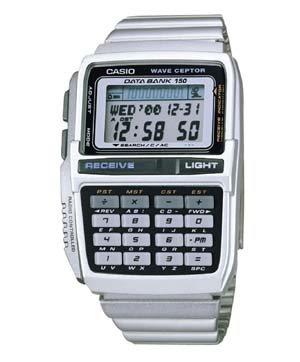
For most of my life, I have been fascinated by clocks. Ever since I was a baby, I had an affinity for timepieces. Even the subject of time travel has had an allure to me (not too surprisingly, Back To The Future is one of my favorite movies of all time). I have been collecting clocks of all shapes and sizes most of my life, and have always liked having a large array of them set up at one time (much like Doc Brown's experiment as seen at the beginning of Back To The Future). In the past few years, my collection has focused largely on clocks which are powered and synchronized by the AC power line. Currently, I have around 73 line-powered clocks, 28 of which are mechanical-analog, 15 of which are mechanical-digital, 23 of which are LED/LCD/fluorescent-digital, and 7 of which are other digital. I also own a Casio "Wave Ceptor" DBC-W150 wristwatch (seen here) which receives calibration signals from the WWVB station in Fort Collins, CO, and helps me keep the clocks in close synchronization (though they tend to drift a few seconds ahead or behind WWV, due to a slight inaccuracy in the supplied line frequency).
Analog
My first electric analog clock was a Jefferson Electric "Golden Hour" clock (pictures and info available here). Golden Hour clocks were made for over 40 years, and are fairly easy to find nowadays. The Golden Hour is classified as a 'mystery clock', since there is no visible means of moving the hands, which are attached to a round piece of glass, and appear to float in midair. A motor in the base turns a gear attached to the glass, which rotates at 1/60 RPMs. The minute hand turns along with the glass, while the hour hand is further geared from the minute hand to make one rotation every 12 hours. This makes for an elegant timepiece, and one which is also functional. Apart from replacing the motor (still available today from Timesavers) and power cord, mine has required little maintenance. Due to the transparent face, it's neat to place objects behind it, which makes for an interesting effect. I used to place a tall 811A vacuum tube behind it, which looked pretty cool, especially with the bright filament of the 811A lit.
I also collect conventional electric analog clocks, many of which were made by Telechron and General Electric. Telechron was founded by Henry Warren, who invented the self-starting line-synchronous motor in the early 1900s. Before then, electric clocks were not very accurate, and needed to be started manually (usually through a 'spinner knob' which was attached to the motor). Telechron was later bought by General Electric, but clocks continued to be made under the Telechron name for decades afterwards, with some of them all-but-identical to their GE-branded counterparts.
Among my collection of Telechrons is a 4F51, also known as the "Telart" (pictures and info available here). It is a beautiful clock, and works perfectly. Similar is the 4F61, also known as the "Pharaoh" (pictures and info available here), which I picked up at an antiques store for $15. More conventional than the 4F51, it has a wedge-shaped wooden case, and a square dial. Its motor is a bit slow, and the case has some scratches on it, but it shouldn't be too hard to fix up. I also own a 3H159, also known as the "Suave" (pictures and info available here), which I picked up at a flea market for $30. Unlike the Airlux seen below, the Suave's case is made from real glass. Very heavy, and very pretty to look at from any angle. The face is a bit hard to read, but that's par for the course with a clock like this, and it runs fine.
One thing Telechron/GE was known for were alarm clocks, one of which was the 7H141, also known as the "Airlux" (pictures and info available here), which I picked up at a flea market for $10. It is a very common clock, and mine's in somewhat-shoddy shape (the plexiglass is crazed on the sides, and I had to repair the wiring at the coil), but it's still a nice clock. Similar to this is the GE 7F54, known as the "Deb Alarm" (pictures and info available here). Based on the 4F52 "Debutante", it has a chrome case (it was also available in gold), and a bell alarm (common on Telechron/GE alarm clocks until the '40s). The metal cover around the motor and alarm guts has split in several places, but the clock runs nicely, and the alarm works fine. The oldest (and, IMO, the coolest) of these is the 711, also known as the "Telalarm" (pictures and info available here). One of Telechron's first alarm clocks (and one of the first line-powered alarm clocks ever), the 711 and its derivatives were very popular. The 711 (and its GE-branded lot-mate, the AB712) have lighted dials, while the 715 and AB716 didn't. The housing of my 711 has a small crack in the upper left corner, and the glass over the dial has a small crack or other defect in the bottom right corner, but is in great cosmetic shape otherwise, and works perfectly (apart from a little flicker in the lamp brightness, possibly due to a dirty rheostat dimmer control).
I also have some of their older table clocks, one of which is a 327, otherwise known as the "Salisbury" (pictures and info available here). It's a small tambour clock with a pattern below the dial; unfortunately, the rotor has seen better days. Similar is the 370A, otherwise known as the "Vernon" (pictures and info available here). It, along with the similar 370 "Clinton", were the first two Telechron clocks to employ a dial lamp. Unlike their later illuminated alarm clocks, which placed the light at the bottom of the case, these clocks had the lamp at the top of the dial, shielded by a mirrored ring in the circumference of the glass. The only difference between the Clinton and Vernon is that the Vernon had a fancy pattern etched in front of the mirrored ring, while the Clinton didn't. My Vernon has some discoloration on the dial, as well as some damage to the mirrored ring, but is otherwise in nice shape. Similar to yet different than the 327 and 370A is the 355, also known as the "Cathedral" (pictures and info available here). While its cabinet is a similar shape as the previous two (and similar to that of 'cathedral radios' like the famous Philco 70/90), it is made of bakelite rather than wood. It actually sold quite well, and was copied numerous times (I own an example of these; merely marked "Electric" on the dial, it uses a Hammond-style 'spin-start' movement, as detailed below). It needs a new cord, but is in good shape otherwise. More conventional is a 560, known as the "Bennington" (pictures and info available here). A traditional 'mantel clock' design, the front has some nice carving in it. Unfortunately, the dial glass is missing, the dial bezel is loose, and the power cord needs to be replaced. The most interesting of these is actually not a Telechron, strictly speaking, but does use a Telechron motor: a Revere chiming mantel clock (possibly model R-602). Built by the Herschede Clock Company, who also made conventional springwound chiming clocks, these Revere clocks generally employ a Westminster chime (Telechron's own 6-series striking clocks only sounded the hour and half-hour). Unfortunately, the Revere chiming clock I have currently doesn't work, and needs a new power cord; hopefully, I can manage to fix it at some point.
I also own a number of wall-mount Telechrons, one of which is a white/ivory 2H07 "Buffet" (pictures and info available here). Yet another classic deco design, these were produced for longer than just about any other Telechron clock, surviving into the '50s. Mine appears to be from the late '30s/early '40s, with a plastic backplate (as opposed to the masonite ones used later on), but with a short rubber cord rather than the long cloth type seen on earlier versions. The short cord, combined with a special recessed outlet, made the look more aesthetically pleasing, since there was no longer a visible wire hanging down from the bottom. It's a bit noisy, but otherwise runs fine. I also have a white/ivory 2H25, also known as the "Stewardess" (pictures and info available here). Like the Buffet, it has a deco-ish design to it, though not quite as stylish. Also like the Buffet, it's a bit noisy, but does run. Similar to the 2H25 is the 2H11, also known as the "Cafe" (pictures and info available here. They both have square cases, but the Cafe has chrome accents on the sides. They're so similar that early Stewardesses had the same round-in-square dial as the pre-war Cafe (which is the version I have), but later switched to a dial with the numbers arranged in a square layout, which post-war Cafes also sport. This clock needs a new cord, and the case is dirty, but it's otherwise in good shape. A later example of their home wall clocks is the 2H69, also known as the "Dutch Treat" (pictures and info available here). Typical of later GE/Telechron clocks (they'd mostly abandoned the Telechron name at this point), the metal plate surrounding the clock face has an interesting painted design on it. I'm guessing it was made to be used in the living room rather than the kitchen as with most other 2-series clocks. The clock itself is in good shape, but it isn't running. Similar to this is the 2H111, also known as the "Festival" (pictures and info available here. The plastic 'crystal' is loose because all of its tabs have broken off, but it's in good shape otherwise, and runs (though I won't be able to use it much unless I install a 'clock outlet', as the power cord is only a couple of inches long).
I also have a number of Telechron and GE's basic "commercial clocks", which can still be found happily keeping time in schools and businesses decades after they were manufactured. One of the ones I have is a General Electric 1HA1612, which has a 12" dial. Mine has a chrome-style coating (which has seen far better days) on the case; not sure if it's original or not, since the plastic in the uncoated areas seems to be brown. Perhaps the most interesting of these is what I believe to be a 101 (pictures and info available here), possibly one of the first Telechron clocks ever (back when they were still known as the "Warren Telechron Clock Co."). It sports a small (8") round dial within a square wooden case, unlike their later series of commercial clocks which used round cases made of metal, fiber, or plastic. The reset signal is much cruder than with later clocks, being a little flag labeled "RESET" which drops into the clock face area when not being held out of the way by the motor coil's magnetic field. This clock is in rough shape, and a bit noisy, but should clean up nicely. Similar is what I believe to be a 301 (pictures and info available here). It's largely the same clock as the 101 except that it has a 14" dial, a second hand, and a hole for a regular reset signal in the middle of the dial (the signal itself seems to be missing, oddly enough). Someone mounted a chain to the top of the wooden case, which is in surprisingly good shape otherwise. The wood on the rear door has delaminated somewhat, the cord has been replaced with a 3-prong type, and the motor is a bit noisy, but it's held up well over the years.
I also have some non-Telechron/GE analog clocks. One of them is a Waltham mantel clock (model unknown). Waltham was better known for their springwound pocketwatches and wristwatches, and only made electric clocks for a brief period of time. Unlike most mantel clocks, the case on this Waltham is only about an inch thick; I'm guessing it was an economy model of some sort. I haven't tested this clock, because the mechanism is all gummed up. I also have a Waltham wall clock of some sort with a metal case, but I haven't tested it either. Speaking of wall clocks, I have a pair of electric "commercial" wall clocks from the '70s, a Seth-Thomas, and a Westclox, both of which run. The Seth-Thomas has a brown outside ring and plastic dial lens, while the Westclox has a 'salmon' (pinkish) outside ring, and a glass dial lens. The Seth-Thomas is similar, if not identical, to an electric wall clock which they still sell today. Semi-related is a Tradition electric wall clock (possibly sold by Sears) which looks like a mini-version of a "Regulator"-style pendulum clock; the motor has noisy bearings, but it runs. I also have a Westclox S-7G, known as the "Greenwich" (pictures and info available here). The original Greenwich debuted in the 1930s (using a Sangamo motor), but a later version appeared in 1950. The oddest thing about this clock is that, according to the nameplate on the back, it was intended for the Canadian market, and meant to be run on 25Hz current! However, when plugged in, it seems to run at a normal speed (a 25Hz clock powered by 60Hz current would run WAY too fast), so the rotor was likely replaced with a 60Hz type at some point. The alarm and reset signal don't work, but hopefully, they'll be fairly easy to fix. Possibly the most interesting of these is a Mastercrafters 191 wall clock. Mastercrafters specialized in novelty "motion clocks" (as seen here); the 191 is almost conventional, except that its 8" dial sports 24-hour markings, as well as a rotating disk with city names on it. The disk rotates along with the hour hand, allowing you to keep track of time in all parts of the world. The motor in this clock is noisy, but it does run. More about Mastercrafters clocks can be found below.
Going back to the mantel clocks, I also have a Hammond (model unknown) from the '30s or early '40s (with a much more traditional case style than the above Waltham). Laurens Hammond, like Henry Warren of Telechron, was an early pioneer of the synchronous electric motor (to avoid infringing on Warren's patents, Hammond clock motors weren't self-starting, requiring the use of a spinner knob as mentioned above). Hammond started making clocks in the late 1920s; due to various difficulties, including patent issues, Hammond soon looked for other uses for his synchronous motor, resulting in the famous Hammond tonewheel organ (of which I own an example, a model M "spinet" from the early '50s). Unfortunately, the original Hammond movement from this clock was discarded sometime in the past, and replaced with one from a Sessions (another electric clock manufacturer) "banjo clock". The replacement mechanism runs nicely, but I'd like to find a real Hammond clock movement someday.
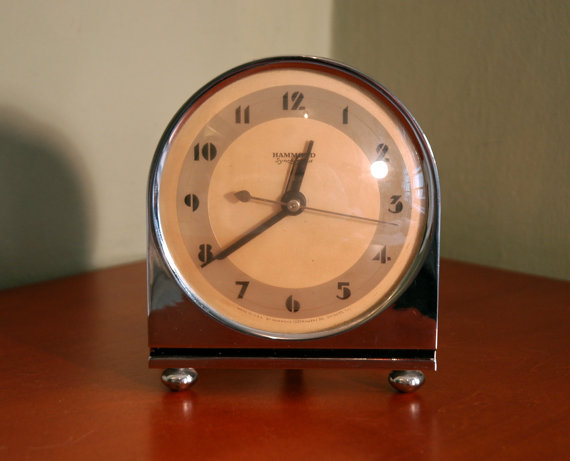
Similarly, but much more authentic, is a Hammond P-1310 "Grenadier" desk alarm clock with a chrome-front case, and its original spin-start Hammond motor. Unlike most alarm clocks, the alarm set dial is located on the back of the case, rather than being integrated with the main clock face. An earlier version of this clock (with the same model number) was sold as the "Polo"; the only visible difference is the look of the face, and the design of the back of the case, including the alarm dial (not entirely sure why they decided to change the model name; I think the number refers only to the case front). My guess is that it's a later design, since the writing on the bottom of the clock face identifies the company as the "Hammond Instrument Co." rather than the "Hammond Clock Co." as on earlier models (the company changed its name in 1937, since they were much more identified with the Hammond organ by this time, and stopped making clocks altogether four years later). This clock reminds me very much of my Telechron 4F51, with the art deco case, hands, and numerals. Best I can tell, both the clock and alarm parts work fine, though tilting the clock forward sometimes causes the motor to stop.
Another non-self-starting electric clock I have is a Hamilton-Sangamo S-406, also known as the "Sanford". Sangamo Electric, generally known for watt-hour meters and other instrumentation, began producing electrically-wound clocks (using a motor to wind the mainspring of a pocket watch movement) in 1926, and briefly produced a synchronous motor-powered clock (after teaming up with the Hamilton Watch Co. in 1929), but the Great Depression took its toll, and they sold their clock division to General Time & Instrument Co. (makers of Westclox and Seth Thomas clocks) in 1931. An interesting feature of these clocks is the seconds indicator, a metal disk within the middle of the clock face, behind the hour hand. Unlike Hammond clocks, the Sangamo uses a small lever to start the motor. My S-406 has a few issues with the finish, but is generally in good shape, and runs pretty well.
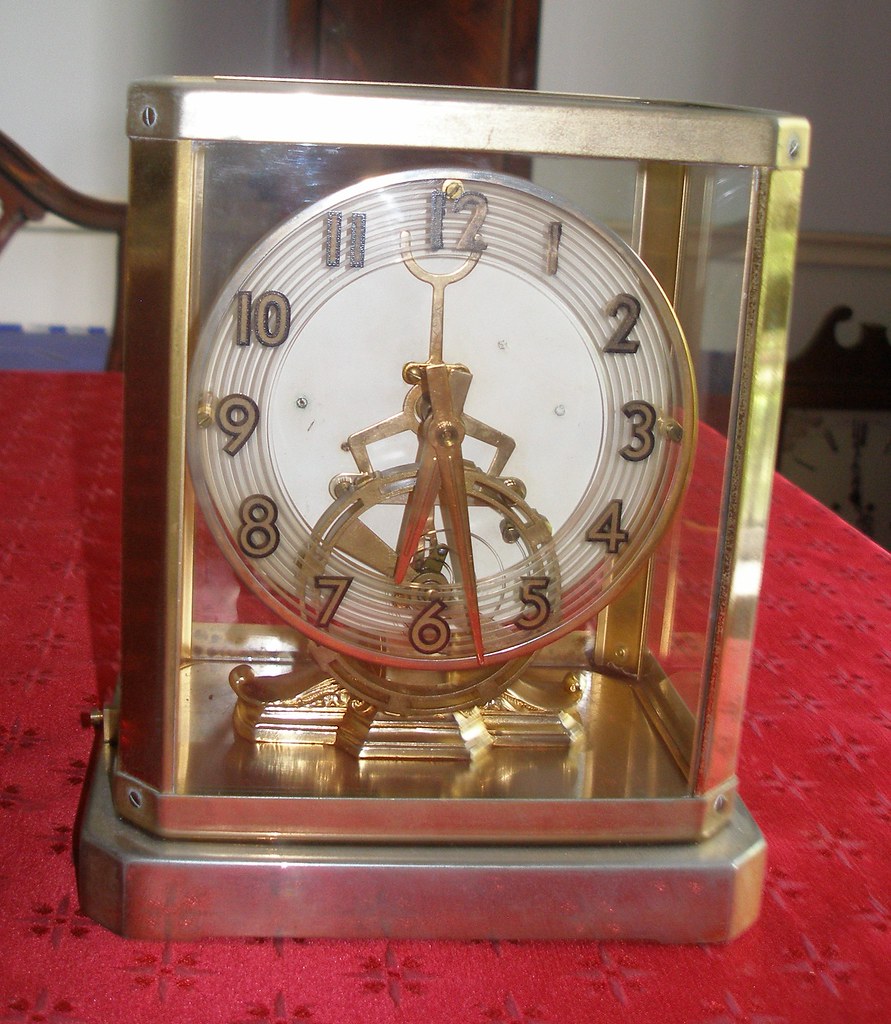
Possibly the oddest of these is the Mastercrafters 308. It was heavily modeled after the famous Jaeger-LeCoultre "Atmos" clock, designed in the late '30s, and still made today. Unlike the Atmos clock, whose mainspring is wound by an ingenious mechanism which makes use of minute changes in temperature and barometric pressure in the air, the Mastercrafters 308 runs using a conventional synchronous electric motor (and cost a fraction of the price). The 308 looked so similar to the Atmos clock that Jaeger-LeCoultre sued Mastercrafters and won, forcing them to change the design. My 308 had a cracked glass panel on the top when I got it, but it's been replaced. One of the phenolic gears used to drive the mechanism got a bit mangled, but I was able to get it repaired; I bought a replacement from Mike's Clock Clinic to use as a spare, in case anything else goes wrong. Similar to the Mastercrafters is a United Clock "Unitime" model 999. Like the Mastercrafters, the Unitime is based on a fancy mantel clock, this time apparently the Eureka clock from the early 1900s, though the style of its case and face are closer to that of the Mastercrafters 308/Atmos. The 'balance wheel' in the Unitime acts similarly to the real thing, oscillating back and forth using a spring mechanism (as opposed to the Mastercrafters, whose 'pendulum' constantly rotates counter-clockwise instead of reversing direction every couple of seconds like a real Atmos). The Unitime works nicely, and makes a great companion to the Mastercrafters 308.
Mechanical Digital
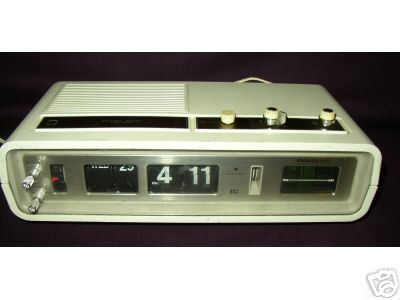
Most of my mechanical-digital clocks are of the "drop-leaf" type (the numbers are on small plastic cards, which flip down to the next minute; they are often referred to as 'flip clocks'). One of them is a Panasonic RC-6551 clock radio (picture available here), from around 1971. It is quite elaborate, having a day/date calendar in addition to a time display (the day and date automatically update less than an hour after 12 midnight, though months less than 31 days in length have to be compensated for manually). When I acquired it, the motor didn't move at all. I used a series of oils to bring it back to life, after which it served for several months on my bedside table, until a tragic fall caused one of the digit leaves to break off from the mechanism. I have since acquired another Panasonic calendar clock radio, a similar RC-6493, which is awaiting restoration. More conventional than these is the RC-6010, which I have a pair of. No calendar display, and they don't even have snooze buttons, but they're still decent, and run nicely.
I also have some flip clocks which don't have an alarm at all. One of them is a Hallmark-Ricoh 3600, which I bought at a flea market for a buck. It practically screams "1970s" with its funky day-glo orange plastic case, which has a trapezoidal shape to the front, and a rounded back. I have another clock which is nearly identical, but sports a different brand ("Sun Valley", model 1030 "Digiclock"), and has a deep red case. Both clocks are in good shape, and run fine. Possibly the coolest of my flip clocks is a Copal 801, which has larger digits on it than any of my other flip clocks, around 3" tall. It is unique in that it can either sit on a desk (using a chromed metal stand, which seems to be missing on many of these), or be wall-mounted. At least some of these used several neon lamps to illuminate the digits, but mine never had them. The motor in my 801 is sluggish, losing several minutes a week; I'm hoping that a deep cleaning and re-lubrication will solve this.
I also have some 'scroll clocks', the type with numbered reels which smoothly roll down to the next minute. I have a trio of '70s GEs (often referred to as "dice clocks", since the reels have several sides instead of being round), as well as a couple of Numechron "Tymeter" clocks from the '50s and '60s, which uses similar reels (one of which even offers a 24-hour time readout). I also have a Sankyo 412, which uses round reels, and has a stylized rounded-front rectangular case. A different type of scroll clock is the Lux 5010-01 I acquired. Instead of the motor driving a seconds reel which then triggers the minutes reel to turn, some sort of spring-loaded mechanism is involved which would jump the minutes reel ahead at the proper time. Mine doesn't work as it should; instead, the minutes reel is constantly moving at a very slow rate. Hopefully, I'll be able to figure out what's wrong with it someday. Quasi-similar is the Ropat "Talisman 15" alarm clock. It seems similar to the Lux, but unlike it (or any of my other mechanical-digital clocks), it's battery-operated (runs on a single D-cell battery), using a clockwork mechanism which triggers a small motor to advance the digits every minute. Also unlike my other scroll clocks, it keeps track of the day of the week. It didn't work when I got it, but after some lubrication of the clockwork mechanism, as well as some repairs to the alarm dial, it works fairly well.
Electronic Digital
Most LED clocks are fairly unremarkable, since the designs are static and boring. However, some of them manage to stand out from the rest, such as the Micronta 63-814, from the late '70s. In addition to the standard hours/minutes adjustments, by moving a switch, the seconds count is displayed instead, along with the ones digit of the current minute. When setting the time, the seconds count can either be reset to 00, or stopped where it is, for synchronizing with other clocks. I have owned three of them, all yard sale finds; one of them stopped displaying time correctly shortly after I bought it, but the other two are still working. Similar to these is a GE 8143-5, which also has a seconds count, though it's viewed by pressing the Snooze button, and can only be altered by pressing the Slow Set button to advance the minute. Back in the Micronta department, I also own a Micronta 63-766. It has a 2" large display, and can be switched to display 12- or 24-hour time. In the early '90s, these clocks were relabeled and sold as "audio system enhancers" by various less-than-reputable companies, such as Tice Audio; I don't know if it has any effect on the sound from my stereo, but it keeps pretty good time. Similar to this one is the Micronta 63-805; it uses the same sort of 2" LED display (also switchable for 12/24 hours), but is meant to be wall-mounted (lacks an alarm function). Possibly the oddest of these is the Micronta 63-906, also known as the "VoxClock 3". Radio Shack's top-of-the-line alarm clock for several years, it not only tells the time (and date) on the LED display, but also audibly via voice synthesis (remarkably intelligible for 1985-era technology). It also offers dual alarms with "crescendo alarm", as well as optional time announcement and electronic chimes. Some of the buttons are dirty, but all of the features work as they should.
I also have some non-LED digital clocks, such as the MFJ 102. MFJ is a company which makes accessories aimed at ham radio operators. The MFJ-102 is a somewhat-conventional vacuum fluorescent alarm clock, but like some of the Microntas listed above, has a switch that allows 12 or 24-hour readout. Oddly, unlike any other digital clock I have, the AM/PM indication in 12-hour mode makes use of the leftmost upper and lower segments of the leftmost digit on the display. Exactly why they did this instead of using a display with dedicated AM or PM markings within the VFD panel is unknown, but it does make some sense, since those segments are never used in 12-hour mode (they are, however, used in 24-hour mode, since single-digit hours are displayed as "0x").
In the clock radio department, I have a GE 7-4870, which is somewhat unique in having a digitally-tuned radio section. It features a keypad, which allows you to tune stations in .2MHz increments, as well as to select and store four station presets (shared between AM and FM). I have seen other GE clock radios with similar functionality, including two models with direct access tuning using a numerical keypad (the 7-4880 and 7-4885), but all of them seem to have issues with flaky button contacts. Similar to this is a GE 7-4665A. While it doesn't have the digital tuning features of the 7-4870, it does have versatile time-setting controls, and a handy dimming knob for the fluorescent display, as well as a "power failure tone" (though it and the alarm buzzer don't seem to work like they should).
I also have a Proton 420 which, like the GE, offers digital tuning with presets and two alarms, but also has many other features, like variable alarm volume. It has a matching extension speaker (RS-421) which allows for stereo listening, but also adds remote controls for the radio, and a secondary snooze button (intended as a "his 'n' hers" setup, to go on opposite sides of the bed). I also have a Proton 320, which is mono, and has an analog tuning dial, but is otherwise similar to the 420. In a similar vein to the Proton 420 is a Panasonic RC-X310, which also employs two speakers, but has them entirely separate from the main unit rather than the Proton's main/slave setup (more like a small boombox, really). Each alarm is supposed to sound through a separate speaker; I'm not sure how effective this is, but it should prove interesting nevertheless. Possibly the most interesting of these is the Chronomatic 309, which was Radio Shack's top-of-the-line clock radio in the mid-late '90s. It features stereo speakers, sports a full cassette recorder on the top, and a nice green LED display. About the only thing it lacks is digital tuning, though it has a red LED in the center of the dial pointer. Some of the switches and controls are dirty, but the unit works perfectly otherwise.
Some of my digital clocks are the 'industrial' type, in that they were meant for a specialized use. I have a pair of Simplex "Celestra 2000" flush-mount clock/speaker panel assemblies. They were meant for use in schools, as well as other institutional uses. The clock has 2" high LED digits, and can either be controlled by a central master clock, or run as a stand-alone unit. The speaker is 8", and designed to be used with 'talk-back' systems (it can also act as a microphone, to allow communications back-and-forth with the main office). I also have a couple of rack-mounted clocks. One of them is a Radio Systems CT-6 which, like the Simplex, has 2" tall digits. It, too, can be controlled by a master clock, though it has a built-in synchronization circuit, and it also functions as a timer. I have yet to figure out all of its functions, but it does seem to work as a clock, at the least. Similar, but much less elaborate, is the ESE ES-174M. The display is only 0.4" tall, but it's an interesting little clock nevertheless. They were typically sold as panel-mount, like older digital voltmeters, but mine is attached to the middle of an otherwise-blank 2U rack-mount panel. It has a card-edge connector on the back for external connections, but I have yet to find a pin-out (fortunately, it offers buttons for setting the time on the front bezel).
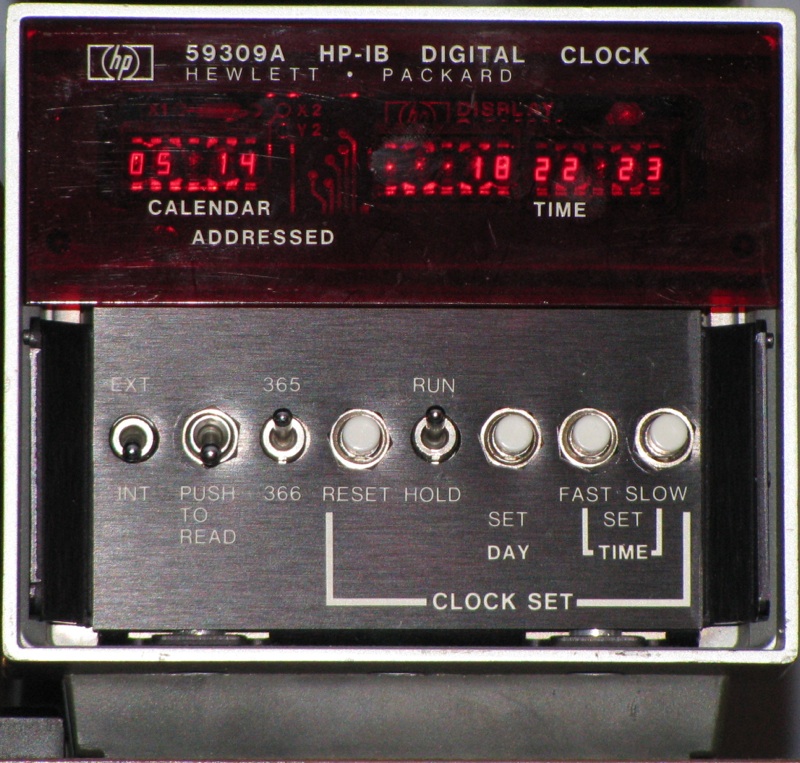
Probably the oddest of all of these is the Hewlett-Packard 59309A. Built by the same company that made test equipment and calculators (later known for their computers), the HP 59309A was intended as a "real-time clock" reference for their HP Interface Bus (later known as General Purpose Interface Bus (GPIB), or the IEEE-488 interface) minicomputers, particularly the 9800 series. It has a display on the front, which uses the same sort of tiny 'bubble' digits most often seen in calculators of the time (such as the HP-35), and can display both time and date. It's likely that the display was put there almost as an afterthought; it's meant to be used briefly while setting the date and time, though someone replaced the momentary pushbutton display switch with an on/off toggle switch sometime before I got it. This allows the display to be read constantly, though the size of the digits means you have to be within a few feet to read it clearly.
Homebrews
I attempted to build a simple MM5314-based six-digit LED clock in high school, but it has yet to work correctly. I did succeed in building a Velleman MK151 LED kit clock, which uses a specialized PIC chip. I also have two ongoing Numitron (RCA neon-filled seven-segment display, similar to a nixie tube) clock projects, both using Sal Brisindi designs. In addition to these, I have several homebrew-type clocks which were made by other people. One of them is similar to the first one I tried to build; it uses a MM5313 IC, which is similar to the MM5314. It has four yellow LED digits, and a nice metal case; it displays gibberish hours when first turned on, but once the time is advanced past those hours, it seems to work normally. Similar is another MM5314-based LED clock which someone built into a small wooden box. Some of the display digits have missing segments; I'm hoping it's due to bad solder joints between the main and display boards (replacing some toasty-looking resistors on the main board should help). Another one I have is more complicated than these other LED homebrews; apparently, it not only offers time (in 24 hours!) and alarm (with sleep and snooze), but also temperature readout (I believe it's missing the sensor for this, unfortunately; apparently based around the LM334 chip). All of its various buttons and switches are adorned with little Dymo labels near them, and the grill holes for the alarm speaker were obviously hand-drilled. It's based around a circuit board made by National Semiconductor (model MA-1026) which uses an epoxy blob IC on one side, and has the LED display mounted to the other. Not sure what it was built for, but it should prove interesting regardless. I also have a similar clock, based around a different NS module (MA-1008). It seems to have been intended as a demo model for a commercial product of sorts, built into a nice wooden case, and sporting a plastic panel above the display bearing Dymo labels reading "YOUR CALL SIGN HERE" (the actual sold item would likely have had a custom-engraved panel installed there for the ham radio operator who bought it).
Some of the homebrew clocks I have use nixie tubes, an early digital display method utilizing number-shaped wires within a neon-filled glass tube. One of the nixie clocks uses three nixie tubes, as well as a long neon lamp for the hours tens digit; unlike the aforementioned clocks, it's based on discrete TTL logic chips rather than a "clock-in-a-chip" like the MM53xx series. It appears to have been scavenged for its transformer, which is a shame since it would be interesting to see it in action. I also have one which was sold as a kit by a company called "B&F Enterprises" in the early 1970s. Like the aforementioned nixie clock, this one also uses TTL logic chips, but has a full six nixie tube display (with buttons to set hours, minutes and seconds, interestingly enough). The front of the case simply identifies it as a "Digital Clock", though the board sports a model number of "Z1000". When I first got it, it was blowing fuses; replacing the filter capacitors and the diodes in the high voltage power supply fixed this, though it occasionally glitches up for some unknown reason. More info on this clock, as well as pictures, can be found on this page.
I also have several Heathkit clocks, mostly from the mid '70s. One is an ID-1490, which is a combination clock/dual thermometer using several pairs of Panaplex gas-discharge display modules. The clock portion of this unit works, but there's some issues with the thermometer section. I also own a GC-1094, which is basically a rehash of Heathkit's first digital clock offering, the GC-1005 (and akin to the alarm clock section of the ID-1490), using the same Panaplex modules. The display has a flickering problem, which may be due to the Panaplex modules being old, or drifted parts in the multiplexer. Similarly, I have a GC-1092A, which was the 'deluxe' version of the GC-1005. The GC-1092A has a touch-activated snooze button, a dimming feature, battery backup (can't figure out how the batteries are supposed to be installed), and an odd trapezoidal case. While one of the Panaplex digits has issues, the rest of the display is flicker-free, and it keeps good time. In addition to these, I also have a GC-1107, which is similar to the GC-1094, but uses a more conventional fluorescent display (like the GC-1094, it's been wired to display time in a 24-hour format). Like the clock portion of the ID-1490, this unit works fine. Unique among these is the GC-1093. It uses Panaplex displays like most of my other Heathkit clocks, but was meant to be installed in a car, and runs on 12V DC. It not only keeps normal time, but can be set to keep track of elapsed time during a trip or somesuch. I haven't done much testing yet, but it seems to work fine thus far.
The most interesting of my Heathkit clocks is the GC-1000, aka the "Most Accurate Clock" (as seen in the original ad). Introduced in 1983, it was one of the first radio-controlled clocks available to the general public. Instead of tying its time regulation to the power line frequency, the GC-1000 uses shortwave WWV time frequencies at 5, 10 and 15MHz (not WWVB at 60kHz, like modern radio-controlled 'atomic clocks') to initially set itself, and to periodically re-synchronize itself with NIST's atomic clock using a digital time code embedded within the signal. It's also one of very few consumer-grade digital clocks with a 1/10th second indicator (some of Longines' 1960s nixie clocks did as well, possibly as an homage to their sporting event timing systems). I was told by the person who sold it to me that its LED display wasn't working; I found a small switch on the side that turns the display on and off, and flipping it brought the display back to life. When connected to my outside long-wire antenna (it's missing its internal 54" telescoping antenna; I'm hoping to find a replacement someday), it's usually able to acquire the time signal from WWV after a little while. I replaced the old electrolytic capacitors on the main and tone boards, and swapped out the 7805C 5V regulator chip (which tends to run quite hot in these clocks, as detailed on this page) with a modern switching replacement (made by Murata) to allow the clock to run cooler. It indeed does, but the switching regulator introduces some RF "hash" noise into the clock's receiver section. I'm trying to figure out a way to minimize the problem, but for the time being, it's still able to pick up WWV nicely in strong signal conditions.
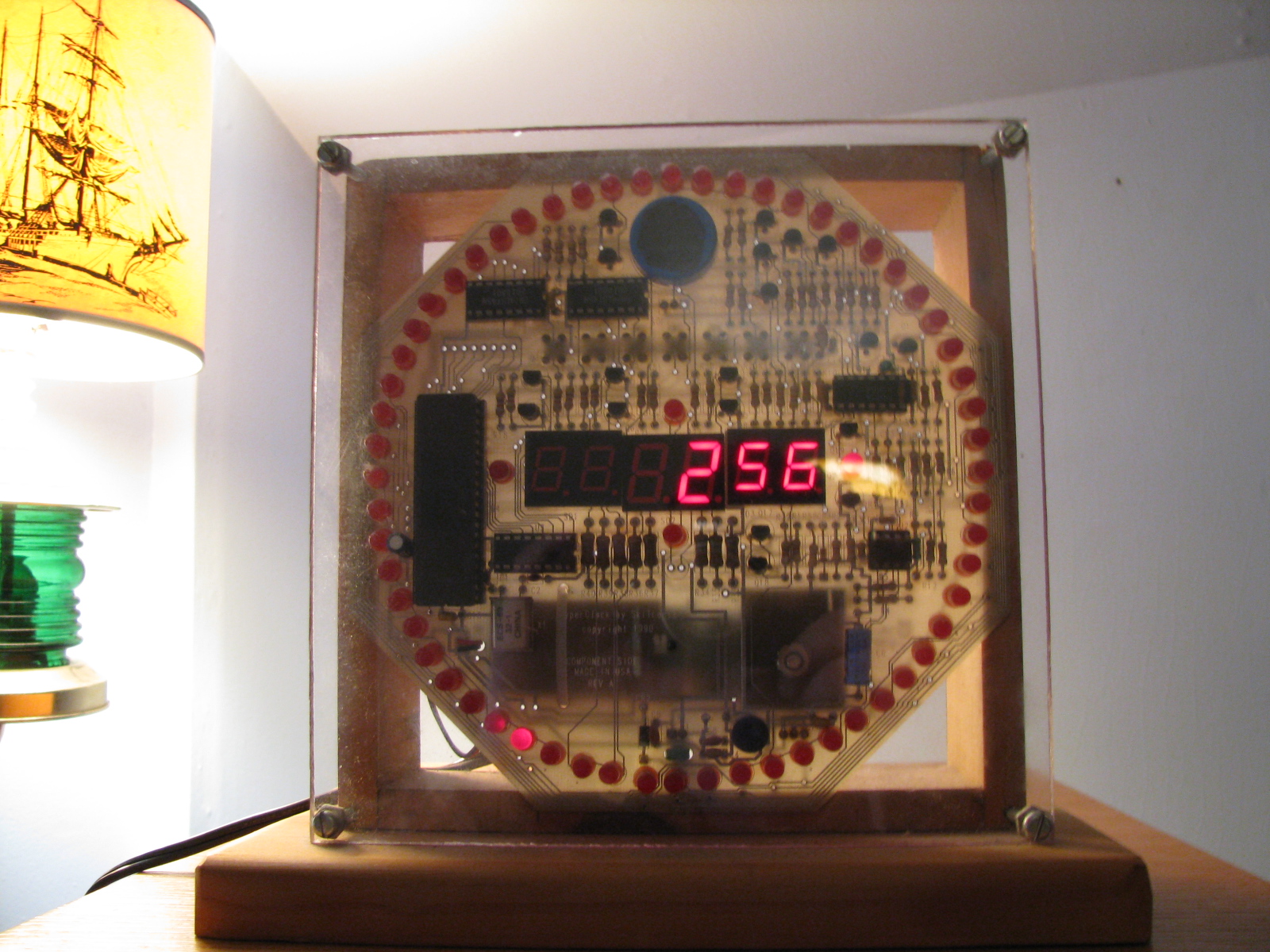
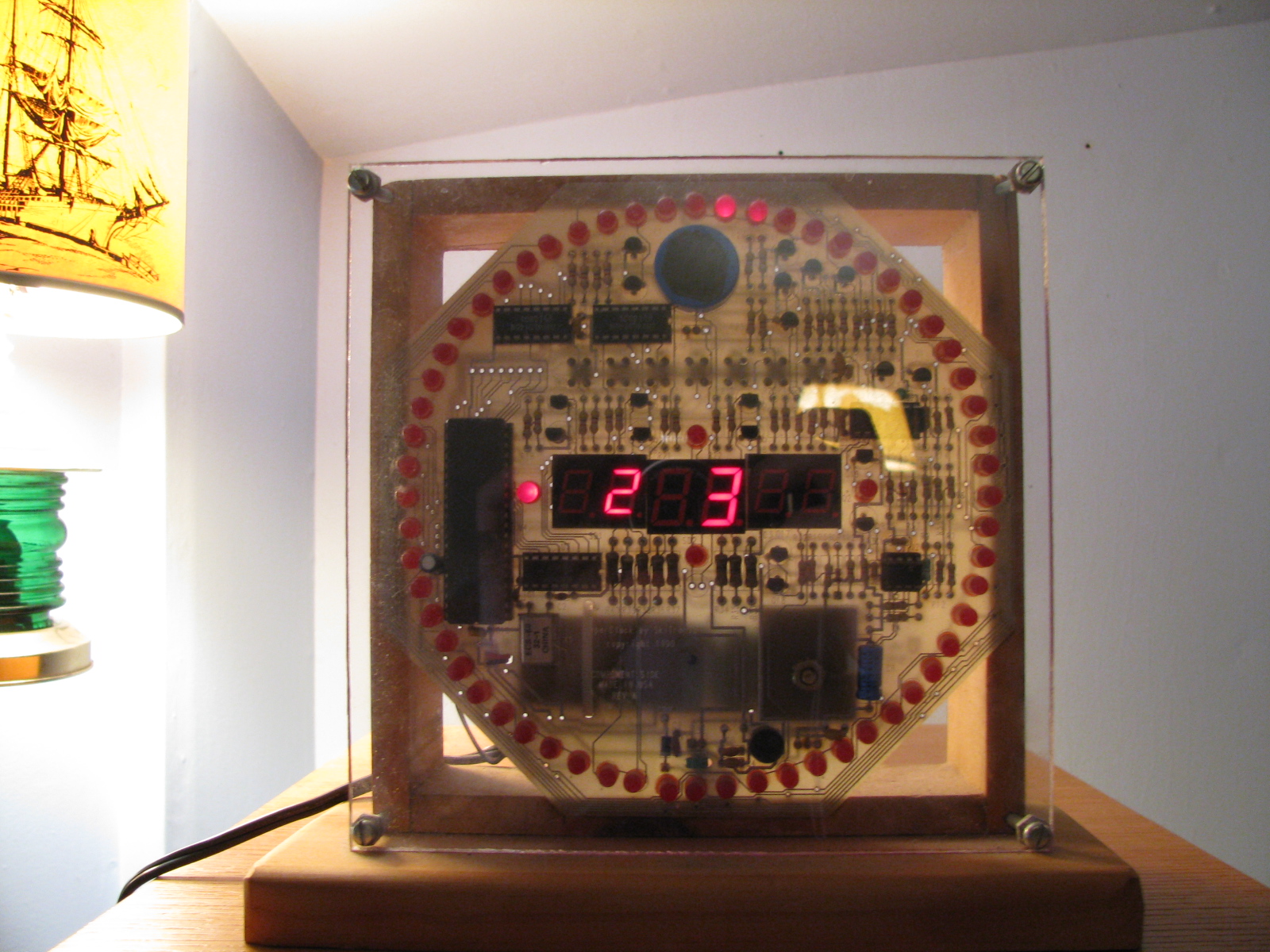
In a class by itself is the HyperClock, designed as a kit by a small company called "Skitronix" in the early '90s. Comprised of a octagonal printed circuit board (which has been mounted in a plexiglass-fronted homebuilt wooden case), it sports three pairs of seven-segment LED displays, 60 LEDs arranged in a circle (which can be set to display either seconds elapsed, or low/high tide) around the perimeter of the board, and four more LEDs around the seven-segment display array. The HyperClock is extremely versatile, offering two different time display modes: a standard hour/minute display (pictured here displaying 2:56:35AM), or an alternate mode which shows how many minutes have either elapsed since the hour began, or how many are left until the next hour begins, whichever number is lower (pictured here displaying 2:58:01AM). It also offers two different display change modes (normal mode, or a "flowing" mode which gives the effect of one increment fading into another). In addition, it sports a month/date calendar, an alarm mode with snooze function, battery backup, and even an hourly chime. As you can probably tell from the description above, operation of the HyperClock is rather complicated; setting the time and selecting the various displays/modes involves the use of seven mini pushbuttons mounted to the back of the circuit board, none of which are marked. I was able to determine which button did what through sheer trial-and-error, and even so, I still can't be sure that I've figured out everything that it can do. Since I wrote this, someone kindly supplied me with a manual for it, as well as a copy of the original Popular Electronics article it appeared in (if you would like a copy of these, email me using the address at the bottom of the page).
Site Navigation:
Return to the other stuff section!
Return to the main page!