Adam's Antique Radio Page
Old radio links
Phil's Old Radios
Padgetts TransOceanic Page (for fanatics only)
Antique Radio Forums
Antique Radio and Phono Newsgroup
My crystal radio page
My Trans-Oceanic page
My boatanchor radio page
For more old radio links, see my links page!
Radios in my Collection (in order of acquisition)
- Ray-Jefferson 630/RDF multiband marine receiver (197?)
- Hallicrafters S-118 communications receiver (1962)
- Zenith K615 AM table radio (1963)
- GE T238B AM/FM table radio (196?)
- Zenith "TransOceanic" B-600 portable multiband radio (1962)
- Automatic Radio "Tom Thumb" tube portable AM radio (1947)
- Zenith "TransOceanic" Royal 1000 portable multiband radio (1960)
- Zenith H723Z2 AM/FM table radio (1951)
- Sony TFM-9440W AM/FM table radio (197?)
- Zenith X316 AM/FM table radio (1967)
- Arvin 30R12 FM table radio (1961)
- Telechron 8H67 "Musalarm" AM clock radio (1947?)
- Zenith "TransOceanic" model Royal 3000-1 portable multiband radio (1968)
- Zenith X375 AM/FM clock radio (1967?)
- Columbia "Masterwork" 2894 portable multiband radio (1970s?)
- Motorola 61T21 AM/SW table radio (1941)
- Zenith "TransOceanic" model 8G005YT portable multiband radio (1946?)
- Admiral 12X12 television (1950)
- EAC R-390A/URR military communications receiver (1967)
- Collins R-392/URR military communications receiver (1951)
- Philco 38-12 AM table radio (1938)
- Zenith "TransOceanic" H-500 portable multiband radio (1951)
- R-F-T Super 5080C "Teraphone" MW/SW European table radio (1950s?)
- Grundig-Majestic 2120-U MW/SW/FM European table radio (1960)
- Atwater Kent 55C AM radio chassis (1929)
- Atwater Kent 20 AM table radio (1924)
- Zenith H725 AM/FM table radio (195?)
- Hallicrafters S-72 portable communications receiver (1950?)
- Philco 38-9 AM/SW table radio (1938)
- Crosley 51 AM table radio (1925)
- Atwater Kent 545 AM/SW table radio (1935)
- Zenith "TransOceanic" Royal 1000 portable multiband radio (1957)
- Zenith Royal 2000 "Trans-Symphony" AM/FM portable radio (1960)
- Philco 70 AM table radio (1931)
- Grundig Transistor 500 portable multiband radio (1966)
- Zenith "TransOceanic" Royal D7000Y portable multiband radio (197?)
- Zenith Royal 500E AM transistor radio (1959)
- Bendix R-1051B/URR military communications receiver (196?)
- Zenith 6S511W AM/SW table radio (1941)
- Zenith H845 AM/FM table radio (1964)
- FADA 192A "Neutrolette" AM table radio (1925)
- Atwater Kent 55 AM table radio (1929)
- Benrus 10B01B15B AM clock radio (1955)
- Grundig Satellit Transistor 5000 portable multiband radio (1964)
- Philco T9-126 "Trans-World" portable multiband radio (1959)
- Zenith J733 AM/FM clock radio (1952)
- Zenith D720 FM table radio (1961)
- Heathkit SB-102 ham radio transceiver (1970)
- Realistic DX-150 communications receiver (1968)
- Zenith 9S262 AM/SW console radio (1938)
- General Electric 7-2880B "Superadio" AM/FM portable radio (1979?)
- National NC-183D communications receiver (1952?)
- Realistic DX-150A communications receiver (1972)
- Zenith Royal 500H AM transistor radio (1961)
- Zenith L507 "Meridian" portable multiband radio (1953)
- Grundig Transistor 11 portable multiband radio (1962?)
- Zenith "TransOceanic" L600L portable multiband radio (1954)
- Zenith "TransOceanic" R-7000-2 portable multiband radio (1981)
- Stewart-Warner T-195/GRC-19 military communications transmitter (195?)
- Zenith TransOceanic 8G005YT portable multiband radio (1946)
- Drake TR-4C ham radio transceiver (1973?)
- Drake SSR-1 communications receiver (1976)
- Hammarlund BC-779 military communications receiver (194?)
- Yaesu FRG-7 communications receiver (1977)
- Zenith "TransOceanic" R-7000-2 portable multiband radio (1981)
- KLH model 21 AM/FM table radio (1965)
- RCA 2X621 AM/SW table radio (1952)
- Heathkit GR-21 FM table radio (1962)
- Braun T1000 portable multiband radio (1963)
- Collins R-388/URR military communications receiver (195?)
- TMC GPR-90 communications receiver (1955)
- Sony "Earth Orbiter" CRF-5100 portable multiband radio (1975)
- Heathkit GRB-151-2 AM transistor radio (1965?)
- Hammarlund SP-600 communications receiver (1953?)
- Grundig Transistor 301 AM/FM portable radio (196?)
- Grundig Transistor 16 multiband portable radio (196?)
- General Electric 7-2885F "Superadio II" AM/FM portable radio (1987?)
- Zenith "TransOceanic" G500 portable multiband radio (1949)
- Heathkit HW-101 ham radio transceiver (1970)
- Sony KV-1710 television (1972)
- Zenith "TransOceanic" Royal 7000 portable multiband radio (1970)
- Sony ICF-6500 portable multiband radio (1982?)
- Zenith Royal 500 AM transistor radio (1956)
- Arvin 9598 "The International" portable multiband radio (1959?)
- Panasonic RF-2600 portable multiband radio (1979)
- Emerson AN/GRR-5 military communications receiver (1959)
- Heathkit CR-1 crystal radio (1962?)
- Panasonic R-1837 AM transistor radio (1965?)
- Tento VEF 206 portable multiband radio (1975?)
- Sony ICF-2010 portable multiband radio (1985)
- Bang & Olufsen Master 39K AM/SW table radio (1939)
- Sony ICF-5500W portable multiband radio (1975?)
- FADA 1000 "Bullet" AM table radio (1945)
- Allied Radio Knight-Kit "Star Roamer" communications receiver (1964?)
Welcome to my antique radio page!
I have an affinity for old radios as well as old computers. My first find was a Ray-Jefferson 630/RDF multiband marine receiver, which was given to me by a relative. Meant to be used on a boat, it has inputs for 12 volts DC only, though it also takes batteries. The five bands are AM, FM, MB (marine band; just above the AM broadcast band), LW (longwave; below the AM broadcast band) and VHF (above the FM broadcast band). its distinguishing characteristic is a large, rotatable directional antenna (with a compass ring surrounding it), designed to fine-tune signals coming from all different directions (it's meant to be used with MB, though it may also work with AM and LW). These sets aren't particularly common, but they made several different versions, some even including LCD digital tuning.
My second find was a Hallicrafters S-118 communications receiver. In its time, Hallicrafters was a well-known manufacturer of quality communication recievers. Many are still in good working order even today. The Hallicrafters S-118 was produced in 1962, and cost $100 when new. It features nearly-continuous coverage from 190KC to 30MC, split up into 5 bands: LW (longwave, covering 190KC to 420KC), BC (broadcast AM band, covering 495KC to 1.6MC), and SW (shortwave, covering 1.6MC to 30MC in three bands). The radio has a separate dial for bandspread (allowing for very fine tuning adjustments), as well as a sensitivity control (a bit scratchy), a BFO (Beat Frequency Oscillator, allowing for reception of single sideband (SSB) transmissions) switch, a receive/standby switch, an input/output jack on the back (used as an output when in receive mode, and as an input when in standby mode), and ANL (Automatic Noise Limiter) switch, and other functions. All in all, a terrific reciever. (See more about it on my my Hallicrafters page ).
My third find was a Zenith K615 AM table radio. I was sent this radio by a friend. It was produced in 1963, and has a plastic cabinet (like many of my other radios). It has six tubes, unlike standard "All-American 5" AM table radios, making it an "All-American 6." The radio has excellent reception and sensitivity due to the extra tube in the RF section and what Zenith called a "Filter Magnet" antenna (Zenith had many nicknames for their radio antennas; another of which is the "WaveMagnet" as seen on the TransOceanic series). A picture of my K615 can be found here.
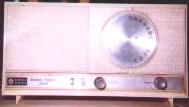
My fourth find was a GE T238B AM/FM table radio. I bought this radio at a flea market for $15. This was my first tube radio with FM. I haven't been able to find this radio on any of the antique radio web sites I've checked. Does anyone know when this radio was made, or any other information? If so, please email me using the email address at the bottom of the page. a picture of it can be found here.
My fifth find was a Zenith "TransOceanic" B-600. It was given to me by a friend. It is a good performer, and picks up many shortwave stations. See more about it on my TransOceanic page.
My sixth find was a Zenith "TransOceanic" H-500. It was given to me by a friend. Unfortunately, unlike most of my radios, this one is dead (hums on AC, is silent on batteries). I am considering trading it for another T-O model. More about it can be found on the TransOceanic page. 6/17/19108 UPDATE: I decided to sell this set at the April 2008 NEARC swap-meet. Hopefully, its new owner will be able to do something with it.
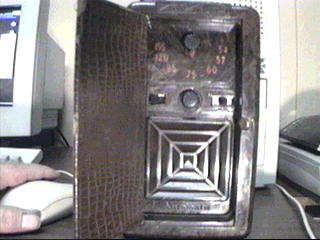
My seventh find was an Automatic Radio "Tom Thumb" tube portable AM-only radio. It was given to me by a friend. This was my second Automatic Radio (the others are transistor car/portables that I have not made a page about; I will make a page about my transistor radios later). I haven't plugged it in yet. Here's a lengthy description that I posted on the rec.antiques.radio+phono newsgroup:
"It looks
like a tall but skinny lunchbox (reminds me of the napkin dispensers found at
some restaurants). It is AC/DC/Battery. It is mostly leather-covered except for
the plastic surrounding the front and back covers, which is a weird swirled brown plastic.
Molded into the plastic above the door and colored orange are the words "Tom Thumb". On the front,
only the leather that the plastic surrounds opens as a door. Under the front
cover there's frequency numbers molded into the plastic (the scale goes from 155-54,
not 54-155), a tuning knob (works like a vernier dial; there's supposed to be a
pointer attached underneath the knob, but it is missing; anyone got a spare?),
a volume knob, a power switch, the words 'Automatic Radio', a weird-looking square speaker grille, and a BATT./AC-DC/CHARGE (?) switch. The back
looks identical, although the entire back cover, plastic and all, opens. The
"chassis" (not a box, but just a flat piece of metal) is the oddest I have seen
in all the radios I have. On top of the plate is the tubes, IF/RF transformers,
tuning capacitor and selenuim rectifier. Underneath is exposed electronic parts
(wax capacitors, resistors, wiring; looks to be a real shock hazard).
Underneath the parts is a can capacitor, speaker, back of the potentiometer, an
output transformer, a pair of snap connectors for a B battery, and a weird
battery case with a hinged top for some sort of A batteries (C cells I think).
Behind the back cover is a spiral molded into the plastic in which the cord is
held. The plate on the back of the back cover reads 'Automatic Radio serial no.
508878 model Tom Thumb. Automatic Radio Mfg. Co. Inc. 122 Brookline Ave.
Boston, 15, Mass. Made in USA. This apparatus uses inventions of United States
patents licensed by Radio Corporation of America and other patents licensed to
this company, particularly No's 22221996, 2262979, 2265958'. The handle that's
supposed to be on top is missing. From the back I could only see three tubes.
When was this radio made? I'm guessing late 40's to early 50's, but I'm not
sure. As far as I can tell, it uses all miniature tubes. How do I get the
chassis out of the case? I could only find one screw on the back I could
unscrew, and that didn't allow the chassis to be removed. The only tube number
I can see is VT173. What type of tube is this? Also, what is the function of
the charge position on the power selector switch? What rechargeable batteries
did they have in the late 40's-early 50's? Did the charge switch have some
other function than charging batteries. What type of B battery does this radio
take (22.5? 45? 67.5? 90?)?"
I will post pictures as soon as I can have some scanned in. If anyone can help me with the above questions, please email me using the email address at the bottom of the page. 9/7/19100 UPDATE: I've finally found someone who has a radio like mine! A picture of a radio like mine can be found here.
My eighth find was a Zenith "TransOceanic" Royal 1000. I bought it from a friend for $45. It is my first solid-state TransOceanic. More about my Royal 1000 can be found on my TransOceanic page.
My ninth find was a Zenith 6D030Z "Consol-tone" wooden-cased AM table radio. I bought it at the October 2000 NEARC swap-meet for $30 (I think). The graphic-arts instructor at the technical high school I attended once brought me a 6D030 to look at, and now I have my own. It has some veneer damage, but otherwise looks fine. It appears to be a AA6-type radio (35L6GT, 35Z5GT, 12SJ7, 12SA7, 12SQ7, 12BA6). I am not going to power it up until I can slowly power it up with a variac. 08/18/19106 UPDATE: I sold this radio at the July 2006 NEARC swap-meet. its new owner should get much enjoyment from it.
My tenth find was a RCA 67-QR-53W AM/SW table radio. I purchased this at the October 2000 NEARC swap-meet for $20. Despite the American brand name, it's actually a European radio. I know next-to-nothing about it, and little information is available pertaining to them. The tube count is 6BE6, 6BA6, 6AV6, 6AK5, and 6X4. A label on the underside has the following note:
MADE IN WEST GERMANY FOR
Radio Fernseh Elektro G. m. b. H.
AN ASSOCIATED COMPANY OF
RADIO CORPORATION OF AMERICA
If anyone has any information on this radio, please email me using the email address at the bottom of the page. 6/17/19108 UPDATE: I sold this set at the April 2007 NEARC swap-meet. Hopefully, it will make an interesting set for its new owner.
My eleventh find was a Zenith H723Z2 AM/FM table radio. I bought it at the March 2001 NEARC swap-meet for $30. It has a bakelite plastic case, which is in good shape. AM works fine; however, FM seems to have fading problems. If anyone can supply me with a schematic for this radio, please email me using the email address at the bottom of the page. A picture of a radio like mine can be found here.
My twelfth find was a Zenith 7H922 AM/FM table radio. I bought it at the July 2001 NEARC swap-meet for $25. This is my second Zenith AM/FM table radio. I'm not entirely sure of the date of this radio. It looks entirely different than my H723Z2, as it has a plastic dial cover with a pointer underneath it. The front emblem looks like an eagle sitting over a lightning Z, unlike the Zenith shield seen on my H723Z2. I haven't tried this radio, as it needs a new line cord. It appears to have been modified with a phono input and radio/phono switch sometime in the past. A picture of a radio like mine can be found here. 1/4/19102 UPDATE: Since I felt I had too many projects to catch up with, I decided to trade my 7H922 for a Fisher FM-50-B tube tuner. Its new owner, a table radio collector, was quite happy with the trade, as was I.
My thirteenth find was a Sony TFM-9440W AM/FM radio. I bought it at the July 2001 NEARC swap-meet for $10. It's a solid-state table radio from the 1970s, though it could be newer. It resembles many of the AM/FM table radios of the era, with its vertical dial, but the sound quality is very good for a table radio. It has some dirty controls, the dial is a bit off on FM, and the filter capacitors need to be replaced, but other than that, it works good. A picture of a radio like mine can be found here.
My fourteenth find was a Zenith X316 AM/FM table radio. I bought it at the October 2001 NEARC swap-meet for $5. It's the newest tube radio I own, which possibly dates back to 1967. The brown case is somewhat scratched, but the radio works. It appears to be in a style similar to my GE T238B, with a large round dial.
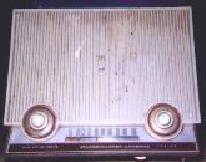
My fifteenth find was an Arvin 30R12 FM-only table radio. I bought it at the October 2001 NEARC swap-meet for $5. I often come upon AM-only radios in my searches, but rarely FM-only radios. Like the Zenith, this one works as well. Quite an interesting set.
My sixteenth find was a Telechron 8H67 "Musalarm" AM clock radio. I bought it at the January 2002 NEARC swap-meet for $20. This is my very first tube clock radio, and my first AM-only radio in some time. It was one of the first tabletop clock radios. At one time, Telechron was the biggest manufacturer of electric clocks (examples of them can be found on my clock page), and made the clock mechanisms for other manufacturers clock radios. What many people don't know is that Telechron had their own line of clock radios in the mid-late '40s. The only way you can tell the brand of the set is from the small Telechron logo on the clock dial. The tuning control is a small numbered thumbwheel above the clock dial area, and the volume control is a somewhat-awkward-to-use thumbwheel under the clock dial area. The alarm is set by a small knob in the 12 o'clock area of the dial, and the radio/alarm function is selected by a knob in the 6 o'clock area of the dial. The clock itself is set by a knob on the rear panel. Both the clock and the radio in this set work, although the radio has hum to it. The 8H67 I bought has a dark brown bakelite case, which I prefer over the blue case 8H67 (which I saw at the same swap-meet on a different table).
My seventeenth find was a Zenith "TransOceanic" Royal 3000-1. I bought it at the Radio XXXIII swap-meet for $120. It is my fourth Trans-Oceanic, my second solid-state Trans-Oceanic, and my first Trans-Oceanic to have built-in FM (I've hooked a car-type FM converter to my B600, but it's not quite the same). It works quite well. More about my Royal 3000-1 can be found on my TransOceanic page.
My eighteenth find was a Zenith X375 AM/FM clock radio. I bought it at the April 2002 NEARC swap-meet for $5. This is my second tube clock radio, and my first tube clock radio to have FM. It seems to be from 1967, the same year as my Zenith X316, and shares many of its features. Its dial is similar to that of my GE T238B, which is also from the mid '60s. It works, although it has a slight hum in the audio, and is missing the sleep timer knob. I have been able to find nothing about this particular model on the web; if anyone has any information about it or a picture of one, please email me using the email address at the bottom of the page.
My nineteenth find was a Columbia Masterwork 2894 portable AM/FM/LW/SW radio. I bought this set at a local yard sale for $9. From the looks of it, this set was meant to be a competitor to the later Zenith TransOceanics, but there are several differences. For one thing, it uses one dial scale for all six bands; this may be more conventional, but it also makes this set a bit confusing to tune (especially since there's nothing to indicate what band you're set to apart from the pointer on the rotary band selector control). Also, it has continuous coverage from 1.7MC to 18MC, which is split into 3 SW bands (1.7-4.2MC, 4.0-10.0MC, and 10-18MC); while this may be a bit difficult to tune, there is a electronic-type fine-tuning control (it does not move the dial pointer). Another feature of this set is a built-in power supply, which T-Os prior to the Royal 7000 series lacked (this set can run on either 120V or 6 C cells). Also, the antenna it uses is more conventional, although it is able to swivel 360 degrees (thanks to an interesting-looking pivot mechanism which seems to resemble a large ball-bearing). This set works well, and comes pretty close to matching my solid-state T-Os in performance, although it seems less rugged. If anyone has more info or some pictures of this set, please email me using the email address at the bottom of the page.
My twentieth find was a Motorola 61T21 AM/SW table radio. I bought it at the July 2002 NEARC swap-meet for $20. From around 1941, it is one of the oldest radios I own. It has a large wooden case and a 5" speaker, which make for excellent sound quality. At first it had some problems receiving shortwave stations, but cleaning the bandswitch solved that problem, and it works beautifully on SW as well as AM. If anyone can supply me with more information on this model, please email me using the email address at the bottom of the page. A picture of this set can be found here.
My twenty-first find was a Zenith "TransOceanic" model 8G005YT. I was sent this radio for free by a fellow collector as a fixer-upper. It is my fifth TransOceanic, and my first loctal-tube TransOceanic. It is currently partially disassembled, but should restore fairly nicely. More about it is available on my TransOceanic page.
My twenty-second was an Admiral 12X12 television. I bought it at the October 2002 NEARC swap-meet for $20. This is my first tube television set. From around 1950, it employs a round CRT (type 12LP4) like all TVs from that era. Also, like many TV sets from that era, it doesn't work all that well in its current unrestored state. The audio section does work, but the video section can be described as being unstable at best. Some screenshots of this set in "operation" can be found here and here. The first picture is of it receiving a station, the other is of it tuned to a dead channel. Obviously, a total recapping of this set is long overdue. If anyone has a copy of the schematic or service manual for this set, please email me using the email address at the bottom of the page. A picture of this set can be found here. Stay tuned! 3/8/19114 UPDATE: After over a decade, this set finally works! I brought it to a friend of mine who works on radios and TVs, and he replaced the old capacitors, as well as some resistors which were responsible for the horizontal issues seen in the above photos. The picture tube is a bit weak, but is watchable. I will take a new picture of the set in operation soon.
My twenty-third find was a Philco 53-958 AM/FM table radio. I bought it at the January 2003 NEARC swap-meet for $29. This is my very first Philco radio. Unlike most of the '50s radios I've come across, this one has a wooden case. While the styling is rather plain for a wood set, it does have some interesting elements to it nevertheless. This radio has a seperate dial for each band, and changing bands will cause the previous band's dial to go dark, and the dial of the band now switched in will light up. This radio works at the moment, but I'm sure that it needs some servicing (the tube chart on the bottom shows no rectifier tube, so it probably has a selenium rectifier). 4/22/19106 UPDATE: Due to an extreme backlog of radios requiring restoration work, I decided to sell my 53-958 at the April 2006 NEARC swap-meet. its new owner is happy with it.
My twenty-fourth find was an EAC R-390A/URR military communications receiver. I acquired this set through one of the teachers at the technical high school I used to go to. It is up and running, and puts many of my other shortwave radios to shame. More about this set can be found on my boatanchor page.
My twenty-fifth find was a Collins R-392/URR military communications receiver. I got this set at the same time as my R-390A. This set is essentially the vehicular equivalent of the R-390A/URR's predecessor, the R-390/URR. More about this set can be found on my boatanchor page.
My twenty-sixth find was a Espey R-48/TRC-8 military communications receiver. I got this set at the same time as my R-390A and R-392. I unfortunately don't know much about this VHF receiver, which was meant to be paired with a VHF transmitter. More about this set can be found on my boatanchor page. 4/22/19106 UPDATE: I sold this set to Allan H. Weiner, owner of the shortwave radio station WBCQ, at the April 2006 NEARC swap-meet. I'm sure he'll get some enjoyment out of this neat set!
My twenty-seventh find was a Philco 38-12 AM table radio. I bought it at the April 2003 NEARC swap-meet for $45. From 1938, it is one of my oldest radios. This was also my first set not to use either octal or miniature tubes (every tube in this set is an ST-type 5- or 6-pin tube). It is a simple 5-tube BC-only set, but it does employ a power transformer. Apart from a lack of sensitivity, this set works fairly well.
My twenty-eighth find was a Zenith 6S511 AM/SW table radio. I bought it at the July 2003 NEARC swap-meet for $41. This set is from 1941, and is my first old radio with pushbutton tuning. This is also my first table radio to employ loctals (used in every tube position except the output tube and rectifier) This set has a plastic case with woodgrain-like brown coloring (it was also made in ivory as the 6S511W). I'm currently not sure of the working condition of this radio, though I have been told that it had been sloppily-repaired sometime in the past. Stay tuned! 6/17/19108 UPDATE: I sold this set at the April 2008 NEARC swap-meet. It should make an interesting project for its new owner.
My twenty-ninth find was a Zenith "TransOceanic" H-500. I bought it at the October 2003 Hosstraders ham-fest for $60. It is my sixth TransOceanic. This set is in better condition than my other H-500, since it actually works to some degree, and the case looks pretty nice. More about it can be found on my TransOceanic page.
My thirtieth find was a 1950's Zenith AM/FM table radio. I bought it at the January 2004 NEARC swap-meet for $15. Unfortunately, the bottom sticker doesn't include model number information, only a chassis number (coming soon). It resembles my 7H922, but with no side control. As of yet, I haven't been able to determine its full working capacity, but I suspect that it has a bad cap in one of the IF transformers (FM reception seems intermittent at best). More later! 4/22/19106 UPDATE: I decided to sell this set at the April 2006 NEARC swap-meet. its true identity will likely remain a mystery...
My thirty-first find was an RFT "Teraphone" Super 5080C MW/SW table radio. I bought it at the Radio XXXV swap-meet for $20. This radio was made in (now-defunct) East Germany. It doesn't quite fit the usual European radio stereotype, being shorter than most of them, with the speaker to the side of the dial rather than above it. The sides of the cabinet are veneer-covered wood, but the front panel is of a white plastic, which contrasts sharply with the cabinet. It features three shortwave bands, covering 2.4-26MC. Like most European sets, this one uses "piano keys" to change bands. Other than a slight hum and a bit of scratchiness in the bandswitch, this set works surprisingly well. More info, including pictures, coming later!
My thirty-second find was a Grundig-Majestic 2120-U MW/FM/SW table set. I bought it at the April 2004 NEARC swap-meet for $25. Unlike RFT, Grundig was based in West Germany, and this set looks much more like a typical European radio. This is my first European radio to feature FM, and also my first radio with an eye tube (an EM84). Cosmetically, this set is in great shape, but because the line cord has seen better days, I haven't tested it yet. More later!
My thirty-third find was an Atwater Kent 55C AM radio chassis. I bought it at the October 2004 NEARC swap-meet for $45. This was my first Atwater Kent radio, and formerly held the place as the oldest radio in my collection (1929). Atwater Kent was one of the first major radio manufacturers, putting out several well-known kit/breadboard radios such as the legendary Model 10. Mine is from the approximate middle of the life of the A-K corporation, when they were starting to make AC-operated sets as well as battery-operated ones. The 55C chassis was usually found in a console cabinet (made by any number of companies such as Pooley, Red Lion, etc.) or a Kiel table, as opposed to the standard metal A-K cabinet which housed the 55 chassis. Mine, however, is not in any sort of cabinet, just an exposed chassis (save for a cover over the tuning/RF section). This set has been tested, and it works well (though the audio level is a bit low). Amazingly, my set still has its 45 tubes present, and several globe tubes. Also, it came with an F-2 speaker, which is not the type specified for this particular model (the F-4 was made for 60Hz-operated sets, and the F-2 was made for 25Hz-operated sets, meaning that the B+ voltage is a bit low when used with a 60Hz set), and is in rough shape (missing its grille cloth, and has some patch-up spots on the speaker cone), but it works ok. If anyone has a source for a cabinet, a correct F-4C (or F-4/F-4A) speaker (would be willing to trade my F-2 speaker for it), or a tracing of the knob opening found on one of the console cabinets, please email me using the email address at the bottom of the page. 2/20/19107 UPDATE: After a long wait, I finally have a Kiel table cabinet to install my 55C chassis in! It's been painted green, and some of the wood has seen better days, but it's otherwise in great shape. Just need to refinish it, and find a proper F-4C speaker to install in it, and it should be all set to go.
My thirty-fourth find was a Zenith "TransOceanic" Royal D7000Y. I bought it at a flea market for $5. It is my seventh TransOceanic, and my third solid-state TransOceanic. It is in rough shape, with a broken hinge on one of the covers, some slight dial warpage, and some dents and dings, but I did well for the price paid. Every band I've tested so far works, although there is some slack in the tuning mechanism. More about it can be found on my TransOceanic page. 08/18/19106 UPDATE: I sold the Royal D7000Y at the July 2006 NEARC swap-meet. its new owner is very happy with it, despite its flaws.
My thirty-fifth find was an Atwater Kent 20 (type 4640) AM table radio. I bought it at the January 2005 NEARC swap-meet for $100. This is my second Atwater Kent radio, and holds the title as the oldest radio in my collection (1924). I bought it along with an Atwater Kent model L horn speaker, which seems to match the set. I have a set of tubes for it, but unfortunately, a couple of the resistors are open, so it currently doesn't work, though that should change soon. More later! 2/20/19105 UPDATE: After replacing the two aforementioned resistors, as well as a weak/gassy tube, the radio now works great! Pics coming soon!
My thirty-sixth find was a Philips "Sagitta" 373. I bought it at the April 2005 NEARC swap-meet for $25. I do not know much about this set. It has a bit of veneer damage, and could use a bit of inner restoration, but seems to work rather well. Like my Grundig, it is equipped with FM, but unlike my Grundig, it is not an import set, so the FM band only goes to 100MHz. If anyone has information and/or schematics pertaining to this set, please email me using the email address listed at the bottom of the page. 4/22/19106 UPDATE: I decided to sell this set at the April 2006 NEARC swap-meet. It should make someone an excellent radio!
My thirty-seventh find is a Zenith H725 AM/FM table radio. I bought it at a flea market for $25. I don't know much about this particular set, other than the model number (which I didn't learn until long after I bought the set). One of the knobs is wrong, and the case is in desperate need of a polishing, but it otherwise seems to be in good shape. I have yet to test this set. More info later.
My thirty-eighth find was a Hallicrafters S-72 portable communications receiver. I bought it at the July 2005 NEARC swap-meet for $50. From around 1950, this set predates the Trans-World series of Trans-Oceanic clones which Hallicrafters put out later. It uses 8 tubes, like the Zenith 8G005 series, though all of them are miniature tubes. Unlike the Trans-World/Trans-Oceanic sets, the S-72 has a different approach to the layout; it is horizontally-oriented like a standard table radio, but meant to sit so that the dial and speaker are facing the top rather than the front (with the cover closing over the top panel). Though it works to some degree, the bands are largely dead at the moment, so it likely needs to be cleaned, as well as recapped. More later!
My thirty-ninth find was a Philco 38-9 AM/SW table radio. I bought it at the October 2005 NEARC swap-meet for $55. This radio dwarfs my other 1938 Philco (which, coincidentally, I bought from the same seller!). The dial on this set looks akin to one used in a tombstone or console Philco. The cabinet on this set is in good shape, and the set works fairly well.
My fortieth find was a Hallicrafters SX-42 communications receiver. It was given to me by a friend. The SX-42 was Hallicrafters' top-of-the-line radio when it was released, and one of the first to feature FM reception. The case is in rusty shape, some of the knobs have seen better days (fortunately, not the metal bandspread knob!), and the guts will probably require a full restoration, but you can't beat the price! More about this set can be found on my boatanchor page. 10/23/19118 UPDATE: I sold this set at NEAR-Fest XXIII. Hopefully, its new owner will be able to get use from its parts.
My forty-first find was a Crosley 51 AM table radio. I bought it at the January 2006 NEARC swap-meet for $100. This is my first regenerative receiver. It uses two tubes, apparently 01As (like my Atwater Kent 20, it didn't come with any tubes). The book-type tuning capacitor is sticky, but other than that, the innards are in pretty good shape. Hopefully, I'll be able to test it soon. 3/25/19108 UPDATE: After lubricating the condenser and refitting the tuning knob, I tested the set out, and it works great! Not quite up to snuff with the Atwater Kent 20, but pretty good for a radio which cost less than a fifth of the price ($18.50 as opposed to $100) when new...
My forty-second find was an Atwater Kent 545 AM/SW table radio. I bought it at the Radio XXXVII swap-meet for $170. This was my third Atwater Kent radio, and my first tombstone radio. One of Atwater Kent's later sets, it features a small airplane dial, and shortwave coverage from 1.7 to around 8MC (I was even able to pick up a "spy numbers station" with it, which I pinpointed to 8.098MC with my R-390A/URR). The total restoration of this particular radio was featured in the February 2002 issue of Antique Radio Classified. According to John Hagman, the man who restored it, the cabinet was in several pieces when he found the set. This would make it a basketcase to most collectors, but fortunately for me, John is not most collectors! The set looks great, and works perfectly.
My forty-third find was a Zenith "TransOceanic" Royal 1000. I bought it at the July 2006 NEARC swap-meet for $140. This is my eighth TransOceanic, and my fourth solid-state TransOceanic. Unlike my other Royal 1000, this one is complete (including the battery box and the detachable Wavemagnet), and is in great shape (very little chrome pitting). More about it can be found (soon) on my TransOceanic page.
My forty-fourth find was a Zenith Royal 2000 portable AM/FM radio. I bought it at the October 2006 NEARC swap-meet for $20. The Royal 2000 is considered a "companion set" to Zenith's TransOceanic series of radios (documented elsewhere on this site). Not a whole lot of info is online about the Royal 2000. From what I've seen, there appear to be at least two variations of this set: one with markings on the knob and detent lines for BASS and TREBLE, and one with no detent lines or markings beyond the word TONE; my set falls into the latter category. On my set, some of the paint has worn off, and the chrome is mildly pitted, but it works perfectly, and sounds great.
My forty-fifth find was a Philco 70 AM table radio. I bought it at the October 2006 NEARC swap-meet for $250. It is my first cathedral radio (and what a way to start...). The Philco 70 cathedral, along with its bigger brother, the 90, share one of the most famous radio designs in history. It has been copied several times for reproduction radios; even Philco themselves (as Philco-Ford) later produced a transistorized AM/FM version of the Model 90. As for my 70, it is in very good shape; the chassis has apparently been recapped (have yet to remove the chassis to check), and the (apparently original) finish looks good. It works quite nicely, though there seems to be a slight intermittent hum.
My forty-sixth find was an Atwater Kent 30 AM table radio. I bought it at the Radio XXXVIII swap-meet for $100. This was my fourth Atwater Kent radio. For the most part, it is similar to my Atwater Kent 20, though the case is smaller, uses six 01As, and it only uses one knob for tuning as opposed to three (a big development in 1926). My example of the 30 is one of the earlier versions, where they used a case originally meant for the Atwater Kent 20C (parts of the inside of the rear panel were carved out to accommodate the larger parts, and a few holes were plugged). As found, the case is a bit scratched up, and the pot-metal tuning pulleys swelled up over the years, causing the brass bands (which allowed the two outer tuning capacitors to track along with the middle one) to snap, but it's otherwise in excellent shape. Due to the tuning issue, I have yet to test it. More later! 6/17/19108 UPDATE: I sold this set at the April 2008 NEARC swap-meet. Hopefully, its new owner will be able to solve its many problems.
My forty-seventh find was a Grundig Transistor 500 portable multiband radio, which was given to me by a neighbor. A product of the mid 1960s, it could possibly be considered a companion set to their Satellit 205 portable multiband radio (known in the US as the Transistor 5000, seen below), similar to Zenith's "Universal" or "Global" TransOceanic companion sets. It offers basic shortwave coverage, along with MW, FM, and LW. This set was more commonly known in Germany as the Music Boy 206, with an 88-100MHz FM band (the Transistor 500 sports the US 88-108MHz FM band), and German markings. This set is complete, including an original Grundig battery eliminator (meant to take the place of the "PP9" battery more commonly found in Europe than the US). Apart from a few minor issues, this set works fairly well.
My forty-eighth find was a Zenith "Trans=Oceanic" Royal D7000Y portable multiband radio, which I bought at the October 2008 NEARC swap-meet for $85. It is my ninth TransOceanic, and my fifth solid-state TransOceanic. It is in nicer shape than the first D7000Y, with no major cosmetic damage (apart from some pitting in the chrome). Every band I've tested so far seems to work fine. More about it can be found on my TransOceanic page
My forty-ninth find was a Zenith Royal 500E transistor radio. I bought it at the April 2010 NEARC swap-meet for $20. The original Royal 500 was Zenith's first transistor radio, and the beginning of a successful model series which ran from 1955 to 1965. The Royal 500E was introduced in 1959, eschewing the matching-color knobs in favor of clear outer knobs, with the volume/tuning markings printed on a silver center disc within each knob. The circuitry was similar to the Royal 500D, which added an eighth transistor to the circuit as an additional RF amplifier, making it a very sensitive receiver. At first, the performance of my Royal 500E was poor, and two of the batteries heated up after being inserted. After removing the chassis, I discovered that one of the battery terminals had come loose from the rear of the battery holder, causing a metal strip between the dual-section battery holder to touch the speaker frame, creating a short circuit. I used electrical tape to hold the terminal in place, as well as insulate the metal strip, and the set now works perfectly. Cosmetics-wise, the gold-tinted chrome around the knobs is heavily pitted, but the maroon plastic case is in decent condition.
My fiftieth find was a Hallicrafters S-38B communications receiver. It was given to me by a friend. The S-38 series of radios was Hallicrafters' entry-level communications receiver for many years, replaced by the S-120 (cousin to my S-118) in the early '60s. It likely needs a restoration, but is in decent shape otherwise. 1/6/19113 UPDATE: I gave this radio to a friend. Hopefully, he'll be able to learn more about tube radios from it.
My fifty-first find was a Bendix R-1051B/URR military communications receiver. I bought it from a friend for $50. Developed as a follow-up to the R-390A (among other receivers), the R-1051 series was designed to be easy to use, as well as to be useful for SSB reception, equipped with frequency synthesized circuitry, and the 1960s equivalent of digital tuning. More about this set can be found on my boatanchor page.
My fifty-second find was a Zenith 6S511W AM/SW table radio. I bought it at the April 2011 NEARC swap-meet for $40. This is my very first plastic radio to sport a painted finish; it is similar to the 6S511 I used to own, but its bakelite cabinet was painted ivory at the factory. For some reason, Zenith opted to put brown pushbuttons and knobs on the ivory-painted version, while using ivory pushbuttons and knobs on the standard brown 6S511. Anyway, I haven't done much testing of this set, but it seems to work fairly well. The ivory paint could use a touch-up in some spots, but is overall in decent shape.
My fifty-third find was a Zenith H845 AM/FM table radio. I bought it at the April 2011 NEARC swap-meet for $8. The H845, and its brethren, are somewhat of a "sleeper" in the tube radio world: they included an extra tube in the AM section as an RF amplifier, and outfitted it with a large 8" speaker, as well as a small tweeter. This gave it better AM reception and audio fidelity than one of their standard 7-tube AM/FM table radios. It could stand to be recapped, and the plastic is a bit yellowed, but it works surprisingly well given its age, and is in decent cosmetic shape.
My fifty-fourth find was a FADA 192A "Neutrolette" AM table radio. It was given to me by a friend. The Neutrolette was a popular "neutrodyne" set of its day. For reasons unknown, this set was stripped of its original bakelite front panel (I'll have to put together some sort of substitute someday), but is otherwise in decent shape. It originally ran on batteries, but somewhere along the line, someone crudely converted this set to run on AC (it sports a holder for 4 D cell batteries likely intended to power the tube filaments, but it's disconnected). I have yet to trace the wiring of these added supplies, to see whether or not it's safe to power up (at the least, it likely needs new filter capacitors, since the conversion was done in the 1960s or so).
My fifty-fifth find was a Hammarlund HQ-129X communications receiver. I bought it at a yard sale for $60. The HQ-129X was one of the first communications receivers introduced for public sale after the end of WWII, in late 1945 or so. It was extremely popular, owing to its impressive performance for the initial release price, and remained popular even after the price increased. Apart from needing a recap, and having mild cosmetics issues, it's in very good shape. More about this set can be found on my boatanchor page. 11/13/19116 UPDATE: I sold this set at NEAR-Fest XX. Hopefully, its new owner will get lots of enjoyment from it!
My fifty-sixth find was an Atwater Kent 55 AM table radio. I bought it at the June 2012 NEARC swap-meet for $35. This is my second Atwater Kent 55; unlike my first one, this one is installed in a green and black metal cabinet, meant for tabletop use. I'm not sure how many of these were sold in this fashion as compared to the 55C chassis (as intended for installation in custom cabinets), but I'm guessing they're a bit harder to find. Also unlike my other 55, this one actually came with the correct speaker, a F-4A external type. Since this set has been stripped of most of its tubes, I will likely use the speaker with my 55C chassis until I can figure out what to do with this one.
My fifty-seventh find is an RCA Radiola III AM table radio. I bought it at a yard sale for $40. Designed by Westinghouse, the Radiola III was RCA's "entry-level" set for 1924, using two tubes, and retailing for $24.50. It's of the basic "regenerative" type, similar to my Crosley 51 as seen above, and only able to drive headphones (they sold an upgraded IIIA model, as well as an outboard balanced amplifier for the III, both meant to drive a horn loudspeaker). It was meant for dry cell battery operation, utilizing a pair of WD-11 tubes, which are extremely fragile and rare. My set came with two pairs of headphones (Brandes "Superiors" and Murdock Radio 3000 ohm), a pair of RCA branded WD-11s (along with their original Radiotron boxes), and a Knight DX-200A tube (likely pulled from whatever radio replaced the Radiola). Unfortunately, one of the WD-11s is a dud, which isn't surprising given how fragile they are, but there are ways to replace them with different tubes. Otherwise, however, the set is in excellent condition for its age, given that it was once used as a mouse nest (amazingly, the battery cable is in near-perfect condition, as is the patent label on the back). I will test the set once I can solve the tube situation. 2/20/19113 UPDATE: I have now acquired another WD-11 tube with an intact filament. I will carefully test this set once I have a chance to hook it up to my ARBE-III battery radio power supply (normally used with the Atwater Kent 20, and occasionally with the Crosley 51). 11/13/19115 UPDATE: I sold this set at the spring 2016 DVHRC swapmeet. Hopefully, its new owner will get much enjoyment from it!
My fifty-eighth find is a Benrus 10B01B15B AM clock radio. I bought it at the September 2012 NEARC swap-meet for $40. This is my third tube clock radio. Benrus was a wristwatch manufacturer, and this was their sole, brief foray into the radio business. They apparently sold this set through their network of watch dealers only in 1955. It is fairly small, yet weighs quite a bit due to the solid brass case, and the glass dial crystal (my guess is that it was fairly expensive). The clock face takes up the entire front panel, with the radio and alarm controls on the sides and rear panel, respectively. Mine sports an off-white face, while others were fitted with a brass-colored face (supposedly, the ones with white faces are rarer than the brass face versions, though I'm not entirely sure; I've seen a version with a blue face, though I'm not sure if it was original). The clock mechanism uses a Telechron rotor, which still runs, though I haven't tested the alarm part. The radio part needs to be restored, as usual.
My fifty-ninth find was a Grundig Satellit Transistor 5000 portable multiband radio. I bought it at the June 2013 MIT Swapfest for $40. It was the first of Grundig's "Satellit" series of solid-state portable shortwave radios, which were intended to compete with Zenith's TransOceanic series. It covers the AM and shortwave bands from 510kHz to 30MHz, as well as LW and FM. Known as the Satellit 205 in Germany, the Transistor 5000 (possibly a companion set to the Transistor 500/Music Boy 206 seen above) was the first of a line which was introduced in 1964 and continued until 1996, ending with the Satellit 700, which I own an example of (Grundig still sells Satellit series radios, but they're made for the company in China). It is very similar to their earlier "Ocean Boy" (see what they did there?) series of multiband portables, but adds a horizontal rotating drum tuning dial with electrical bandspread on the popular shortwave bands (just like Zenith's transistor TransOceanic models, though the rare "Amateur" version actually covered ham radio bands instead!) to the fixed vertical dials of the Ocean Boy 205 it was based off of. Later Satellit models had a vertically-oriented drum dial alongside the vertical fixed ones, then an assortment of horizontally-oriented drum and fixed dials, then finally adding digital tuning (which the Zenith TransOceanic line never sported, outside of the never-produced R-8000 prototype), which eventually replaced the dials altogether. The battery compartment has some minor corrosion in it, and the circuitry could use a tune-up, but it works nicely otherwise.
My sixtieth find is a Philco T9-126 "Trans-World" portable multiband radio. I bought it at the Kutztown XXIX swap-meet for $75. The T9 was Philco's attempt at a solid-state TransOceanic clone, and actually compared well in a 1960 Consumer Reports review. Like the TransOceanic series, the T9 uses electrical bandspread to cover portions of the shortwave band between 2 and 18MHz, as well as the AM broadcast band. Looks-wise, the T9 is closer to that of the contemporary tubed TransOceanic series, sporting a leather-covered wood case, and a large slide-rule dial (an interesting feature of which is a horizontal log scale which slides up and down the dial depending on which band is selected). The leather covering and handle on my T9 are in rough shape, the button clasp to hold the front cover closed is missing, the antenna is a bit kinked, and some of the bands are weak, but it's in decent shape, and works to some degree.
My sixty-first find was a Zenith J733 AM/FM clock radio. I bought it at the September 2013 NEARC swap-meet for $30. This is my fourth tube clock radio. Made of bakelite and other plastics, the J733 has a unique design with the radio dial on one side, and the clock dial on the other. Apparently, there have been a few variations of the J733; mine has three knobs around the clock dial, and the alarm dial as a disk in the middle of the Telechron clock face. The tuning dial needs to be restrung, but the clock radio is in good shape otherwise.
My sixty-second find was a Zenith D720 FM table radio. I was given this radio by a friend. The D720 was the first of a line of FM-only radios Zenith made in the '60s. Fairly nondescript, the D720 uses a flat round dial similar to the one used on the later X316 (which had its own FM-only variant, the X306). This radio has some damage to the plastic front due to having taken a fall at some point, but hopefully won't be too hard to get it looking decent. I have yet to test this set.
My sixty-third find was a Heathkit SB-102 ham radio transceiver. I bought it at the 2014 AARC ham-fest for $200. Part of Heathkit's popular SB-series (referred to as "the poor man's S-line") of amateur radio gear, the SB-102 was the last tube-based model from the series. It's meant for use in the SSB and CW modes on the 80-10M ham radio bands. More about this set can be found on my boatanchor page.
My sixty-fourth find was a Realistic DX-150 communications receiver. I bought it at the Radio XLV swap-meet for $40. The DX-150 was the first solid-state model in Radio Shack's DX-series of shortwave radios (which continued well into the 2000s). Covering 535kHz to 30MHz in four bands, the DX-150 offered the same features as the Hallicrafters radios they'd sold until recently, as well as its tube-based predecessor, the DX-75. The front panel has a number engraved in it, one of the knobs is non-original, and the tuner has sensitivity issues, but it's in good shape otherwise.
My sixty-fifth find was a Zenith 9S262 AM/SW console radio. I bought it from a member of the New England Antique Radio Club for $100. This is my first console radio. Zenith's entry-level 9-tube console from their 1938 radio lineup, it featured motorized tuning, a "magic eye" tuning indicator tube, and their famous 'Robot Dial' with dial scale plates which shifted in and out depending on which band was selected (referred to by collectors as the "shutterdial"). Electrically, my 9S262 is said to be working to some degree, though I have yet to power it up, and am sure it needs new capacitors at the very least (as well as new belts for the tuning mechanism). Cosmetically, the cabinet finish (which is said to be original) is in decent shape, as is the likely-original grill cloth. I hope to get this radio up and running soon; stay tuned!
My sixty-sixth find was a General Electric 7-2880B "Superadio" AM/FM portable radio. I bought it at the April 2014 NEARC swap-meet for $40. The first of GE's Superadio series, which were made from 1979 to 2008, it was designed specifically for high performance on AM (though FM reception is still quite good). Another similar radio I have is the Zenith Royal 2000 "Trans-Symphony", as mentioned above; I look forward to seeing how these two radios compare to each other. This radio is in very good shape cosmetically speaking, and other than a mild intermittent issue, works perfectly.
My sixty-seventh find was a Philips HD-464A portable multiband radio/phonograph. I bought it at a flea market for $20. Built into a large suitcase-like cabinet, the HD-464A offers both a 3-speed manual turntable, and a 4-band radio (a 'transformer-less' chassis using series-string European-type tubes) covering LW, MW (AM), KW (SW), and UKW (FM). This unit was built in the mid-late '50s, and brought to the US from Europe at some point (unlike the Grundig-Majestic 2120-U mentioned above, the UKW/FM dial only covers up to 100MHz). Consequently, I'm not sure if the phonograph has been reconfigured to run at the correct speed when used with a 60Hz line current (the tags inside the cord compartment all say 50Hz, but the voltage switch has been set to 127V instead of 220V, and the plug is a standard US 2-prong type). Before I can do much with it, though, I will have to find a way to repair or replace the phono cartridge (which has separate styli for LP or 78 play, selectable by tilting the headshell) since it appears to be dead at the moment. Oddly enough, the radio works fine for the most part, though the capacitors likely need to be replaced. Cosmetically, it is in decent shape, even sporting the original 45RPM adapter under the top cover. More pictures of a unit like this one can be found here. 2/15/19115 UPDATE: I sold this set at the Radio XLVI swapmeet. I think its new owner will get much enjoyment out of this unique set.
My sixty-eighth find was a National NC-183D communications receiver. I bought it at the July 2014 MIT Swapfest for $100. Best known for the "HRO" series of receivers, National (based in Malden, MA) also made some conventional receivers, and this is considered to be one of their best. This receiver has some hum issues (despite being recapped), as well as sensitivity issues on some of the bands, but it works for the most part, and is in nice cosmetic shape (as is the matching speaker, which I got with it). More about this set can be found on my boatanchor page.
My sixty-ninth find was a Realistic DX-150A communications receiver. I bought it at the NEAR-Fest XVI hamfest for $60. Similar to the DX-150 mentioned above, the DX-150A added a FET-based front end to improve selectivity. It's in much better shape than my DX-150, and has been cleaned and aligned, so it works fairly well.
My seventieth find is a Zenith Royal 500H transistor radio. I was given this radio by a relative. The Royal 500H is considered the last true member of Zenith's Royal 500 series, an example of which can be seen above. Introduced in 1961, the Royal 500H boasted improved audio quality, and an improved circuit design. The cosmetic changes were drastic; gone were the round speaker grille and 'owl eye' knobs of its predecessors, replaced by a large oval grille (to accommodate the new larger speaker) and two thumbwheel dials. It cost $59.99 at a time when transistor radios imported from Japan were starting to break the $20 barrier, and it wasn't too long before Zenith began drastically cheapening their own transistor radio lineup, bringing an age of innovation to an end. My Royal 500H is in excellent cosmetic shape with a very nice two-tone gray case, and still has the original tan leather carrying case. Unfortunately, the volume control potentiometer needs to be replaced, as its carbon track has disintegrated. If anyone has a parts unit, please email me using the email address at the bottom of the page.
My seventy-first find was a Zenith L507 "Meridian" portable multiband radio. I bought it at a flea market for $20. The L507 was a companion to the TransOceanic series; unlike most of the tube T-O companions, the L507 covers two SW bands in addition to AM. Unlike the 600 series of TransOceanics which would be introduced the next year, the L507 uses the same sort of airplane dial as the 500 series T-Os (and, indeed, it appears to be the same brass/black pointer used by the 8G005 and G500 models). This set doesn't work at the moment, though it seems to be in pretty good shape otherwise.
My seventy-second find was a Grundig Transistor 11 portable multiband radio. I bought it at the 2016 Boxboro hamfest for $50. Size-wise, it falls squarely in between my other Grundig radios, the Transistor 500 and the Transistor 5000, though I believe it predates them by a couple of years (it's roughly the same size as my Zenith Royal 2000 T-O companion, though it covers LW and SW in addition to AM and FM). It also seems to be somewhere in the middle in terms of complexity, covering more of the SW band than the Transistor 500, but less than the Transistor 5000. Other than a flaky volume control, this set works fine.
My seventy-third find was a Zenith "TransOceanic" model L600L portable multiband radio. I bought it at NEAR-Fest XX for $35. This is my first TransOceanic to sport a brown leather-covered case instead of the black leatherette used on the other tube T-O models. More about it can be found on my TransOceanic page.
My seventy-fourth find was a Zenith "TransOceanic" model R-7000-2 portable multiband radio. I bought it at a hamfest for $100. The R-7000 was the last in the long line of Zenith TransOceanic radios, and eschewed electrical bandspread in favor of near-continuous coverage, coupled with a mechanical bandspread knob. More about it can be found on my TransOceanic page.
My seventy-fifth find was a Stewart-Warner T-195/GRC-19 military transmitter, which I bought at Kutztown XXXVII for $225. Designed by Collins Radio, the T-195 was meant to be paired with the R-392 receiver listed above as the GRC-19 transceiver set. I have yet to power it up due to the odd voltage requirements (28 volts DC @ 50 amps, with a 250 amp starting surge!), but it seems to be in good shape. More about it can be found on my boatanchor page.
My seventy-sixth find was a Zenith "TransOceanic" model 8G005YT portable multiband radio, which was given to me by a friend. It's in better shape than my other 8G005YT listed above; I'm going to try and turn the two into one working radio. More information about it can be found on my TransOceanic page.
My seventy-seventh find was a Drake TR-4C ham radio transceiver, which I bought at an audio-related gathering for $75. Dating from the mid 1970s, it was probably one of the last all-tube (or mostly tube) ham transceivers introduced. It's similar in concept to my Heathkit SB-102 mentioned above. More about this set can be found on my boatanchor page.
My seventy-eighth find was a Drake SSR-1 communications receiver, which I bought at a hamfest for $100. One of their first general coverage shortwave receivers, it was made for them in Japan, which was unusual for Drake. It uses "Wadley Loop" circuitry as also used in the famed Racal RA-17 tube boatanchor, giving it excellent tuning accuracy and stability. It has some minor cosmetic issues, but works perfectly.
My seventy-ninth find was a Hammarlund BC-779 communications receiver, which I bought at Kutztown XXXVIII for $50. Otherwise known as the SP-210LX, this member of Hammarlund's "Super Pro" line was built during WWII, and covers two LW bands in addition to three shortwave bands (no AM broadcast band coverage, as with a standard SP-200). More info about this receiver can be found on my boatanchor page.
My eightieth find was a Yaesu FRG-7 communications receiver, which I got at Kutztown XXXVIII for $100. Rebranded as the "Sears Communications Receiver", it has a black case as opposed to the standard Yaesu gray, but is identical otherwise. Like the Drake SSR-1 above, the FRG-7 uses "Wadley Loop" circuitry to give it boatanchor-like performance. My example has had "Gilfer Mods" installed, and works great.
My eighty-first find was a Zenith "TransOceanic" model R-7000-2 portable multiband radio, which I bought at NEAR-Fest XXIII for $25. It isn't in as good shape as my other R-7000-2, and will likely serve as a parts unit for it. More info can be found on my TransOceanic page.
My eighty-second find was a KLH model 21 AM/FM table radio, which I bought at an antiques mall for $10. The 21 was KLH's solid-state follow-up to the tubed model 8 table radio, which used an external speaker. The case is in rough shape, and the electrolytic capacitors need to be replaced, but it seems to be in decent shape overall.
My eighty-third find was an RCA 2X621 AM/SW table radio, which I bought at Kutztown XXXIX for $25. The 2X621 uses an AA6 tube lineup, and covers 5.8 to 18MHz as well as the AM broadcast band. I have yet to try this radio, but it's in very good shape overall, and should fix up nicely. More later!
My eighty-fourth find was a Heathkit GR-21 FM table radio, which I bought at Kutztown XXXIX for $40. Somewhat of an oddity, the GR-21 was released in the early 1960s, when FM was starting to grow in popularity. The GR-21 itself is mono; however, Heathkit also made the GRA-21-1 external stereo multiplexer, which I got with it. Both units use tubes; the GR-21 even has a tiny 6M-E5 eye tube, which looks like a miniature 6E5. I have yet to do much with this radio, but they do seem to work to at least some degree.
My eighty-fifth find was a Braun T1000 portable multiband radio, which I bought at the October 2018 MIT Swapfest for $500. Designed by Dieter Rams, the T1000 has an iconic look which makes it sought-after by design fans and radio fans alike, and appears in several museums. Operationally, the T1000 is no slouch, employing 20 transistors (versus 12 as in the Zenith Royal 3000), and covering LW, AM, SW and FM, with near-continuous coverage from 130kHz to 30MHz! My T1000 sports a clear plastic cover over the front panel instead of the metal cover normally seen; I'm not sure whether this was an official Braun option, or if someone had it custom-made for the radio; it looks well-made, and matches the radio well. The (optional) TN1000 internal power supply module is missing, but the unit works quite well on batteries.
My eighty-sixth find was a Collins R-388/URR military communications receiver, which I bought at a flea market for $75. Otherwise known as the 51J-3, the R-388 was the immediate predecessor to the R-390/URR, and the general coverage version of the 75-A amateur band receivers which Collins also sold. More info about this receiver can be found on my boatanchor page.
My eighty-seventh find was a TMC GPR-90 communications receiver, which I bought at the Kutztown XL auction for $150. Dating from the mid-late 1950s, the GPR-90 was similar to the Hammarlund SP-600 receiver, though not quite to the same quality level. More info about this receiver can be found on my boatanchor page.
My eighty-eighth find was a Sony CRF-5100 "Earth Orbiter" portable multiband radio, which I bought at a flea market for $45. A competitor to Zenith's "Trans-Oceanic" line, it has a distinct resemblance to the Royal 7000, which probably wasn't a coincidence. The CRF-5100 offers continuous coverage between 1.6-30MHz, plus AM, FM, LW, aircraft and police bands. I have yet to test this radio, but hope to do so soon. The antenna has seen better days, and the power cord socket is loose, but it's in pretty good shape otherwise.
My eighty-ninth find was a Heathkit GRB-151-2 AM transistor radio, which I bought at a flea market for $10. A simple 6 transistor radio within a leather case, Heathkit offered the standard GR-151 in their catalogs as part of a beginner's set, with a soldering iron and other tools included. This example was apparently supplied as part of an "Advance Schools" home study course, and the front panel bears their name instead of Heathkit's, though the model # sticker inside the back of the case does bear the Heath name. This unit is in decent shape cosmetically, and works perfectly.
My ninetieth find was a Hammarlund SP-600 communications receiver, which I bought at Kutztown XLI for $200. Part of their famed "Super Pro" series of receivers, also encompassing the SP-210LX/BC-779 mentioned above, the SP-600 was a competitor to the R-390 series of receivers, and did quite well by comparison. More info about this receiver can be found on my boatanchor page.
My ninety-first find was a Grundig Transistor 301 AM/FM portable radio, which I got at the Kutztown XLI auction for $20. Probably related to the Music Boy series, the Transistor 301 is one of their few portables which doesn't include some sort of shortwave band. It's in pretty good shape, and seems to work fine.
My ninety-second find was a Grundig Transistor 16 portable multiband radio, which I bought at the September 2019 NEARC swapmeet for $10. Related to the Ocean Boy series, the Transistor 16 is more typical for their portables of the time, including several shortwave bands as well as longwave. The appearance is similar to my Transistor 5000/Satellit 205, except that it's missing the auxiliary drum dial, and isn't as large. It's missing the battery box, so I haven't tested it yet, but seems to be in pretty good shape overall.
My ninety-third find was a General Electric 7-2885F "Superadio II" AM/FM portable radio, which I bought at a thrift store for $5. The follow-up to the original Superadio, which (unlike the II) wasn't branded as such, the main difference is that the II added a tweeter for extended high frequency response. The FM dial readout isn't accurate as I'd like, but it seems to work fine otherwise.
My ninety-fourth find was a Zenith "Trans-Oceanic" model G500 portable multiband radio, which I bought at an antiques market for $100. The G500 is a bridge between the 8G005 models of the late 1940s and the 500/600 models produced for the rest of the 1950s and into the 1960s. More information about it can be found on my TransOceanic page.
My ninety-fifth find was a Heathkit HW-101 ham radio transceiver, which was given to me by a friend. Similar to the SB-102 I already have, this HW-101 is currently in the form of a partially-built kit, which I hope to complete assembly on. More about this set can be found on my boatanchor page.
My ninety-sixth find was a Sony KV-1710 television, which I bought from a local NEARC member for $25. One of the first in Sony's long line of "Trinitron" color television sets, it was their first 'large' CRT model, boasting a 17" screen; their earlier models sported 7" and 12" screens, then 9" and 15" in the same series as this set, with 19" and larger to follow. Like its brethren, it's fully solid-state, making it a good counterpoint to my Admiral 12X12 listed (way) above. Also unlike my 12X12, this Sony worked fully when I got it, though I'm guessing most (if not all) of the parts are original, so it may need work at some point. The Trinitron CRT seems to be nice and bright, and even the original VHF "rabbit ears" are present and correct. A picture of this set can be found here, and screenshots of it in operation can be found here and here.
My ninety-seventh find was a Zenith "Trans-Oceanic" Royal 7000 portable multiband radio, which I bought at a consignment store for $100. It is my fifteenth TransOceanic, and my eighth solid-state TransOceanic. The first model in the Royal 7000 series, it uses a fixed weather band crystal, not offering adjustment options as with later versions. Other than some dirty switches, it seems to work fine on at least some bands. More about it can be found on my TransOceanic page
My ninety-eighth find was a Sony ICF-6500W portable multiband radio, which I bought at Kutztown XLIII for $70. Unlike the ICF-2xxx and 7600 sets, the 6500 is more closely related to the other 6xxx series radios, using an analog dial in conjunction with a digital frequency counter. One nice feature is that, when you change bands, the dial scale changes behind the pointer a'la the solid-state Zenith TransOceanic models. This set is in good cosmetic shape, and works at the basic level, though the bandswitch is dirty (a common issue). Hopefully, it won't be too hard to get working properly.
My ninety-ninth find was a Zenith Royal 500 AM transistor radio, which I bought at an antiques mall for $35. The Royal 500 was Zenith's first transistor radio offering, originally debuting in 1955. The first examples boasted a 'hand wired' chassis in the manner of tube radios, while the Royal 500B which followed a year later switched to a more typical printed circuit board construction. This particular Royal 500 is a rare transitional unit (referred to by collectors as a "500AB" model), sporting the volume and tuning knobs of the 500B, but still having a hand-wired chassis inside the case. The case has a small crack in it, but is in good shape otherwise. It could probably use new capacitors, but works to a fair degree.
My one hundredth find was an Arvin 9598 portable multiband radio, which I bought at a flea market for $10. Nicknamed "The International", the 9598 was likely meant to compete with Zenith's "Navigator" series of lunchbox transistor radios rather than the "TransOceanic" series. Besides AM, it covers the 150-450kHz longwave band, plus a small portion of the shortwave band between 2.1 and 6.4MHz. The leather handle has seen better days, and it probably needs new capacitors, but is in pretty good shape overall.
My one hundred-and-first find was a Panasonic RF-2600 portable multiband radio, which I bought at Kutztown XLIV for $75. Part of their "Command Series", it uses analog tuning combined with a digital frequency counter, akin to the Sony ICF-6500W above. Compared to the Sony, it is considerably more bulky, possibly due to the more complicated innards. Other than a missing carrying strap, the unit is in great shape overall, and works well.
My one hundred-and-second find was an Emerson AN/GRR-5 military communications receiver, which I bought at Kutztown XLIV for $80. Similar in form factor to the Collins R-392/URR, the insides of the AN/GRR-5 somehow simultaneously manages to be both simpler ('only' twelve tubes instead of 25) and more complicated (a versatile power supply able to run on various voltages and types of current, plus a built-in speaker) than its counterpart. More about this set can be found on my boatanchor page.
My one hundred-and-third find was a Heathkit CR-1 crystal radio, which I bought at the September 2021 NEARC swapmeet for $10. My first commercially crystal radio (unless you count Radio Shack's "Project Kit" offerings), the CR-1 is highly regarded due to its simple yet unique design. A group of enthusiasts recently dissected its special tuning coil in order to find out what makes it so effective. Not bad for a 60+ year old design! The example I own seems to be a bit weak, but hopefully that won't be too hard to figure out.
My one hundred-and-fourth find was a Panasonic R-1837 AM transistor radio, which I bought at a flea market for $15. Dating from the mid '60s, it is able to run on both AC and battery, and is equipped with two speakers despite being a mono radio. It uses a vertically-oriented slide rule dial, like some of Panasonic's coat-pocket transistor radio offerings. A chunk is broken out of one of the plastic 'feet' on the bottom, but the radio is in good shape overall, and works decently well.
My one hundred-and-fifth find was a Tento VEF 206 multiband portable radio, which I bought at a flea market for $20. It is my first radio to have been built in the former Soviet Union (second if you count my RFT 5080C from East Germany). Covering several shortwave bands plus long-wave and medium wave (broadcast AM), it is similar in concept to Zenith's early solid-state "TransOceanic" models, though not as mechanically complex. I don't know much about this set other than what I found on this website, which states that it was sold in the UK under the "Vega" name. Since this example doesn't bear that name, I assume that someone brought it here from the former USSR. The band switch knob appears to be a replacement, and the set only works weakly on the set of batteries which it came installed with, but otherwise it's in decent shape for what it is.
My one hundred-and-sixth find was a Sony ICF-2010 multiband portable radio, which I bought at NEAR-Fest XXX for $150. An improved follow-up to their earlier ICF-2001, the 2010 stayed on the market for well over a decade, and is still highly regarded today. This radio is in good cosmetic shape, and seems to work perfectly.
My one hundred-and-seventh find was a Bang & Olufsen Master 39K MW/LW/SW table radio, which I bought at Radio LII for $180. In the United States, B&O was mostly known for sleek-looking audio gear (several pieces of which I've owned over the years), but they got their start in the mid 1920s offering radio equipment in their home country. The Master series was near the top of their table-top radio line, and sports a 'magic eye' tube as well as a set of pushbutton tuning presets. While it doesn't have quite the same level of style as the bakelite Beolit 39 from the same year, it still sports a lovely wooden case with metal accents. One interesting thing about this radio is that a previous owner had a large travel case built for it, which may explain how it made it to this side of the pond, and why it's in such nice shape cosmetically apart from maybe a bit of paint loss on the dial markings. I haven't tested this set yet, though hopefully the previous owner kept it in as nice shape internally as he did for the exterior.
My one hundred-and-eighth find was a Sony ICF-5500W multiband portable radio, which was given to me by a relative. Dating from the mid '70s, it features AM and FM bands, plus a third "Public Service Band" covering 147-174MHz. Built into a fairly small package, it has some interesting features like a pop-up telescoping whip antenna and a sleep timer. The dial is a bit out of alignment, but it works fine otherwise, and has been very well-kept.
My one hundred-and-ninth find was a FADA 1000 AM table radio, which I bought at the November 2021 NorthEast ComicCon show for $400. Known as the "Bullet", this is my first catalin plastic radio, and considered a classic of the genre. This example has evidence of past cracking in the cabinet, but someone did a decent job repairing them. I haven't tested this radio yet, though it shouldn't be too hard to get working.
My one hundred-and-tenth and latest find is an Allied Radio Knight-Kit "Star Roamer" communications receiver, which I bought at a local electronics store for $40. The Star Roamer was intended as a low cost offering for beginner hams, using four tubes plus some solid-state components to cover 200kHz to 30MHz, and also offered extra features like a code practice oscillator. This example of the Star Roamer is missing some parts, and probably needs a lot of work, but hopefully will clean up decently well.
Currently, I have 'only' ninety two old radios (and two old televisions). If you have any old radios you are looking to get rid of, please email me using the email address below.
Site Navigation:
Return to the main page!